




Introduction
Since concrete inherently contains defects, improving its strength requires minimizing these defects, increasing its toughness, and reducing the stress concentration factor at the ends of internal cracks. Adding short, fine, and uniformly distributed PP fibers to cement concrete exhibits significant crack-resistant, reinforcing, and toughening effects. The main purpose of combining fibers with cementitious substrates is to overcome the latter's weaknesses, thereby extending the service life of concrete and expanding its application areas.
What Is Polypropylene Fibre?
Polypropylene fiber, also known as engineering fiber, concrete fiber, crack-resistant fiber, crack-proof fiber, synthetic fiber, or plastic fiber, is a high-strength bundled fiber made primarily of polypropylene using a unique production process. When added to concrete or mortar, it effectively controls micro-cracks caused by factors such as plastic shrinkage, drying shrinkage, and temperature changes in concrete (mortar), preventing and inhibiting the formation and development of cracks. This significantly improves the crack-resistant and impermeable properties of concrete, as well as its impact resistance and seismic resistance, thereby enhancing its crack resistance, impermeability, abrasion resistance, toughness, and extending its service life.

How Does Polypropylene Fiber Improve The Durability Of Concrete?
1. Improved Physical Properties
Reduced Segregation and Bleeding: Uniformly distributed fibers form a three-dimensional network structure, supporting aggregates, inhibiting bleeding and segregation in fresh concrete, and improving workability.
Regulated Setting Time: Low fiber admixture advances the initial setting time of concrete by 1-1.5 hours, and slightly advances the final setting time without affecting workability.
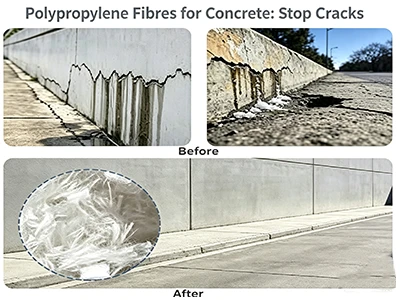
Reduced Shrinkage Cracks: Effectively inhibits plastic shrinkage and drying shrinkage cracks, reducing non-structural cracks by 50%-90%.
2. Enhanced Mechanical Properties
Increased Compressive and Flexural Strength: Significant strength improvement before 0.1% admixture, reducing cracks through crack-inhibiting effects and indirectly promoting strength growth.
Improved Impact and Fatigue Resistance: Fibers prevent crack propagation, enhancing the concrete's ability to withstand impact loads and repeated stresses.
Increased Toughness: Makes the post-cracking strength of concrete higher than plain concrete, improving the flexural toughness index.
3. Enhanced Durability
Improved Impermeability: Blocks capillary cracks, reduces the possibility of penetrating cracks, and improves impermeability by up to 70%.
Enhanced freeze-thaw resistance: Relieves temperature stress, prevents micro-crack propagation, and can more than double the freeze-thaw resistance grade.
Delayed carbonation and alkali-aggregate reaction: Reduces cracking, blocks CO₂ and moisture intrusion, and indirectly delays carbonation and alkali-aggregate reaction.
4. Improved Fire Resistance:
At high temperatures, the fibers melt to form channels, releasing water vapor from inside the concrete, preventing cracking, and significantly improving fire resistance time and grade.

Applications of Polypropylene Fibers
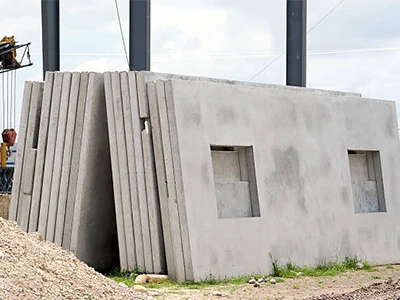
Used in basement pouring, interior and exterior wall plastering, hydraulic engineering, power engineering, tunnels, swimming pools, etc. It improves crack resistance, impermeability, and frost resistance. In highway bridges, airports, and other projects, it enhances impact resistance, earthquake resistance, and abrasion resistance. In shotcrete and concrete, it improves compressive and flexural strength while significantly reducing rebound loss. In mortar and precast concrete components, it improves the overall crack resistance of the components and provides effective reinforcement protection for the edges and corners of precast parts.

How to Use Polypropylene Fibers
1. Polypropylene fibers do not conflict with concrete aggregates, admixtures, additives, or cement, and require no special mixing equipment.
2. Polypropylene fibers are easy to use; they do not require changes to the original concrete mix design, reinforcement ratio, or reduction of the main reinforcing bars.
Accurately weigh the fibers according to the designed dosage and concrete mixing volume. After preparing the aggregate, add the fibers along with the aggregate to the mixer. Extend the mixing time by 30-60 seconds. After mixing, take a random sample. If the fibers are evenly dispersed, the concrete is ready for use. If there are still bundles of fibers, extend the mixing time by 30 seconds before use.
Summary
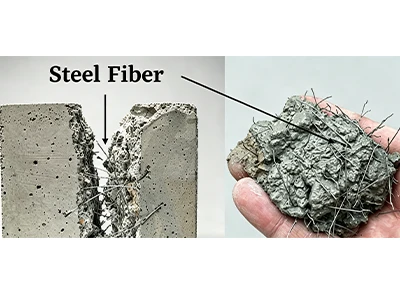
Polypropylene fiber is a novel type of concrete reinforcing fiber, often referred to as a "secondary reinforcement" in concrete. Concrete incorporating polypropylene fibers exhibits improved quality and enhanced overall performance. It is characterized by its simple incorporation process, low cost, and excellent performance. As a novel concrete reinforcing fiber, polypropylene mesh fiber is becoming a new hot topic in the scientific research and application of fiber-reinforced concrete, following glass fiber, steel fiber, and stainless steel fiber.
FAQ
1. What Are The Latest Advancements In Polypropylene Fiber Technology For Concrete?
Modern polypropylene fibers feature optimized lengths, fibrillation patterns, and surface treatments that enhance dispersion in concrete, improve crack control, and increase fire resistance. Some advanced fibers are engineered for ultra-high-performance concrete and precast applications, delivering superior durability and reduced shrinkage.
2. Can Polypropylene Fibers Be Used In All Types Of Concrete Mixes?
English: Yes, PP fibers are versatile and can be added to ready-mix, precast, shotcrete, and high-performance concrete. Dosage and fiber type should be chosen based on the specific application to ensure optimal performance.
3. What Are The Benefits Of Using Polypropylene Fiber In Concrete?
Reduces plastic shrinkage and microcracks, prevents structural cracking, improves impact and abrasion resistance, enhances durability, and offers cost-effective reinforcement without corrosion risk.