




New materials for modern construction, such as carbon fiber-reinforced concrete, have emerged as a game-changer among these revolutionary materials. This innovative composite material synergises the compressive strength of concrete and the tensile properties of carbon fiber, resulting in a construction material that surpasses traditional reinforced concrete in various applications.

How Carbon Fiber Reinforced Concrete Differs from Traditional Concrete
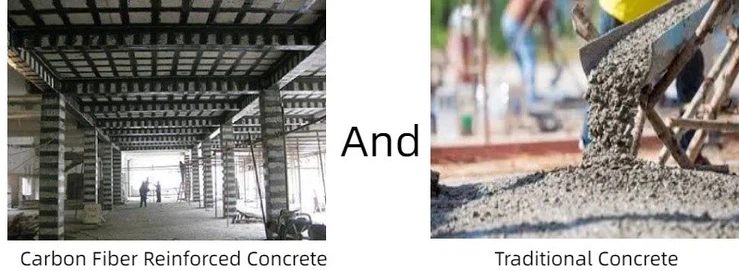
Carbon Fiber Reinforced Concrete (CFRC)
Carbon fiber reinforced concrete (CFRC) is a composite material of carbon fibers in a concrete matrix. In contrast to traditional steel reinforcement, where steel rods are placed inside concrete before curing, carbon fibers are evenly distributed through the concrete recipe to create a 3D reinforcement system that improves its properties.
The carbon fibers used in cfrc are generally derived from polyacrylonitrile (PAN), a petroleum-based polymer. Still, more eco-friendly versions sourced from organic polymers such as lignin (a byproduct of paper processing) are now emerging. These fragile fibres boast an impressive tensile strength of up to five times that of steel while being 80% lighter.
When integrated into concrete, the carbon fibers form a matrix that dramatically strengthens the material's resistance to cracking, increases its tensile strength, and improves its durability. Carbon fiber is a high-performance construction material with many benefits over traditional reinforced concrete.
Comparing Carbon Fiber to Steel Reinforcement

It's essential to compare carbon fiber with the traditional method of reinforcing concrete, steel reinforcement, to see why people adopt carbon fiber concrete applications more frequently. Carbon fibre's fundamental benefits and advantages over steel are immense and multifaceted. Roughly about 80% lighter than steel, carbon fiber significantly decreases the dead load on structures. Strength-wise, carbon fiber possesses 5 times the tensile strength of steel and is twice as stiff.
Unlike steel, carbon fiber will not corrode, thus avoiding the problem of rust, stains, or concrete spalling that come with traditional reinforcement. Therefore, carbon fiber's low thermal conductivity enhances concrete structures' insulation properties. In addition, carbon fiber reinforcement is uniformly distributed in the concrete element and does not require cover as steel reinforcement does.
These characteristics of carbon fiber make it a great alternative to traditional steel for many applications, especially where weight, durability, and corrosion resistance are key issues.
Advantages of Carbon Fiber in Concrete
A structural and a non-structural component in construction, comprising every joint bridge, road, beam, and light and heavy usage area, would be saved from collapse disasters with the option of implementing carbon fiber in concrete.
Structural Advantages
Carbon strip is a strong fiber characterized by rigidity and high strength, and the different factors that need to be addressed are:
Studies have shown that drastic improvements in key performance metrics outweigh the challenges faced in these organisations. Adding only 1% of carbon fiber to the concrete mix resulted in up to 59.9% more compressive strength. The split tensile strength is improved by 56.3 percent when this small amount of carbon fiber is included. The increase in flexural strength is probably the most significant, as it yields increases of up to 107.69% with only a 1% carbon fiber addition. These substantial increases in strength enable the design of thinner, lighter concrete components without performance loss.
Benefits of Durability
Concrete and carbon fiber reinforcement can immensely enhance the material's durability in various ways. This tensile strength reduces or eliminates drying packs and plastic shrinkage throughout the concrete, resulting in more substantial structures. It offers improved impact and dynamic loading resistance, thus finding its usage in areas with vibrations or shock. The material is also more resistant to acids and sulfates than conventional concrete, extending its lifespan in chemically aggressive environments. The carbon fibre reinforced concrete can be used under demanding thermal conditions because of its high thermal resistance, resistance to temperature fluctuations, and high temperatures. Furthermore, it has improved resistance to freezing–thawing cycles, making it useful for cold climate regions, where traditional cement compounds tend to deteriorate considerably.

Construction Advantages
In addition to structural and durability advantages, carbon fiber also has many benefits in construction. This comes from the ability of battened prestressed concrete elements to have a very high strength-to-weight ratio, meaning thinner members can be utilised for the same loads, reducing material quantities and enabling more optimal design. The lighter weight of carbon fiber-reinforced elements lowers transportation costs and eases installation even in the harshest construction environments.
Carbon fiber also tends to eliminate or reduce the need for the placement of conventional steel reinforcement, which can shorten construction time. The decrease in the number of plates utilised leads to lower labor costs and construction time. Additionally, cfrp reinforcement systems are significantly thinner than conventional steel reinforcement alternatives, upholding precious usable space in structures where every dash counts.
Precast Concrete Applications
Precast concrete is a particularly valuable application for carbon fiber, where it can leverage its properties to the best advantage with controlled factory connections.
CarbonCast Technology
One of the most successful and widely implemented uses of carbon fiber in precast concrete is the carboncast system produced by altus group. This technology utilises Chomarat's c-grid, a carbon fiber/epoxy grid, for shear truss in precast concrete panels.
The CarbonCast system has many benefits. The panels are lighter and thinner than conventional precast concrete, which decreases the overall dead load on the structure. This allows for increased panel size potential, minimising the number of pieces needed for a project. Installation is quicker and has fewer, lighter parts to handle. This results in more fantastic material and transportation efficiency, translating to a significantly lower carbon footprint during construction. The system works together with insulated panels and provides high thermal efficiency, optimising the energy performance of finished buildings.
Main Applications of Precast
Precast concrete employs carbon fiber in multiple ways. In wall panels, a carbon fiber grid or mesh is integrated into the outer and inner portions of sandwich wall panels in place of steel reinforcement, mitigating thermal bridging issues associated with steel connectors. In concrete slabs, carbon fiber grids substitute for welded steel grids, allowing for a reduction in weight with equal or enhanced structural performance.
Carbon fiber is a sound reinforcement for parking structures due to its lighter weight and the removal of the need for chemical protection against de-icing salts and other corrosive components. The strength and flexibility of carbon fiber combine to give architectural elements the ability to explore creative and complex designs that would be difficult or impractical to achieve with traditional reinforcement.
Real-World Applications
One of the pioneering applications of carbon fiber reinforced concrete is the carbonhaus on the campus of the Technical University in dresden, germany. This building is the world's first concrete structure to replace steel with carbon fiber in its reinforcement. Located on a site by the German Federal Ministry of Education and Research, and costing in the region of 5 million euros, the innovative structure showcases the possibilities of carbon fiber reinforcement applied to construction. It demonstrates how carbon fiber can provide thinner elements by eliminating the need for steel reinforcement whilst reducing total weight and the risk of corrosion, allowing for structural integrity and safety.
Bridge Strengthening Using CFRP
Carbon fiber-reinforced polymer (CFRP) plates frequently strengthen existing bridge structures. In one study [60], tensioned and flat-plate anchorages were fixed to the ends of a withdrawn full-scale beam extracted from an old bridge around which cfrp plates were bonded (bending adhered on the bottom soffit). The beam's flexural stiffness and bearing capacity were greatly enhanced using this prestressing technique. Research revealed that applying prestressed cfrp could enhance the stiffness at the elastic stage by 64.9% to 67.1% and uplift the ultimate load by 19.53% to 31.9%. This also makes cfrp an excellent option for rehabilitating older infrastructure without entirely replacing it. Significantly less conventional reinforcement in the bridge will corrode due to de-icing salts and moisture exposure, making the corrosion irreparable and leading to premature deterioration.

Household Models with Reduced Energy Costs
So far, the carboncast system has been deployed in several urban settings, including the georgia state university piedmont Central student housing project. The application made significant use of the carbon fiber reinforced precast concrete panels. It drastically reduced the construction time as compared to traditional methods. Whether for a large, standalone facility or distributed energy systems, the system lowered complexity and cost with simplified installation requirements and reduced material use. Environmental benefits included a smaller carbon footprint because of less material use and fewer transportation requirements. Perhaps most importantly for a residential facility, the panels improved energy efficiency with enhanced thermal performance and lower thermal bridging.
The architect for this job reported that specifying c-grid in conditioned spaces is the norm due to lower upfront costs and long-term energy expense savings. This case protects against the adverse effects of a fire with carbon fiber reinforcement, providing immediate construction advantages and an expanding set of ongoing operational benefits.

Challenges and Limitations
Despite its many advantages, carbon fiber-reinforced concrete presents some challenges and limitations that need to be considered.
Cost Considerations
Cost is one of the most significant limiting factors. Carbon fiber materials tend to be more expensive than traditional steel reinforcement. However, the difference in cost can be justified by several other qualities. Lower labor costs on placement during the installation process will usually negate the higher cost of materials since carbon fiber reinforcement is generally more straightforward and faster to place. Less weight means less transport cost, which can add considerable savings on large projects and/or remote locations. It extends service life and reduces maintenance, yielding long-term economic advantages through lower lifecycle costs. Moreover, thunder concrete elements become possible, which leads to reduced overall material use and thus enhances the carbon fiber cost premium offset.
Trickiness, Particularly with the Carbon Fiber Reinforcement
Carbon fiber reinforcement has a few technical limitations to consider, which are something engineers need to keep in mind. Said carbon fiber does come in handy in most concrete structures compared to other structures such as steel or wood, thus limiting its action on different construction systems. Carbon fiber bonding should be done below 60°C to ensure adequate adhesion and strength, and environmental temperature limits of the bonding materials must be maintained. Another critical limitation relates to shear resistance, as the shear resistance of carbon fiber is insufficient in some of the bridge structural applications, which need hybrid solutions or alternative solutions for these specific loading conditions.
Construction Challenges
Integrating carbon fiber reinforcement poses unique construction challenges that require meticulous consideration. The installation requires high expertise and skilled professionals to ensure quality and safety during implementation. The construction process can be complicated, especially for externally bonded systems, which have high requirements during the pasting and fixing process; if the construction is not done well, it will cause the reinforcement effect to be poor and even cause safety hazards. Unmixed and poorly placed fibers can lead to an unaligned distribution of fibers in the concrete matrix, which may sometimes compromise performance. Another challenge is quality control, as confirming the quality of large concrete pours with fiber reinforcement can be difficult without specialized equipment and processes.
Carbon Fiber Content and Mix Design
It has been found that the optimal dosage of carbon fiber is 1% by weight of the concrete. The compressive, split tensile, and flexural strengths were maximum at this concentration and decreased at higher concentrations (1.25% and above).
This new finding will be of enormous importance to engineers and concrete producers interested in reaping the benefits of carbon fiber reinforcement while keeping material costs down. The study also indicates that the workability of concrete (using slump tests) reduces with an increase in the percentage of carbon fibres, with a significant reduction seen at concentrations greater than 0.75%. The effect on workability needs to be assessed in the mix design, often requiring superplasticizers or other admixtures to ensure sufficient flowability for placementability and consolidation.
Sustainability Aspects
There are numerous environmental sustainability advantages in carbon fiber reinforced concrete that fit in with the current focus of modern construction on ecological responsibility. The improved durability and crack resistance offered by cfrc result in a longer service life for structures, requiring less maintenance and replacement in the long term. This durability directly decreases the negative environmental impact of repairing and rebuilding. The increased strength means thinner concrete elements, which reduces the overall amount of cement consumption - a large contributor to the emissions of CO₂ in the building industry. Transportation impacts are reduced as lighter components require less fuel to be delivered to construction sites. This leads to a reduction in energy consumption throughout the life cycle of the buildings.
But there is a noteworthy downside: normal carbon fiber production is energy-intensive. One possible improvement regarding sustainability in carbon fiber reinforced concrete would be the utilization of bio-based carbon fibers obtained from lignin or other organic sources. Shifting production methods to solution and powder, for instance, could lower the embodied energy of that carbon fiber-in some cases while delivering similar performance benefits.
Emerging Trends
As the use of carbon fiber in concrete continues to evolve, several trends are on the forefront. Problem: The sustainability issues linked to the production of traditional carbon fibers have led to the development of bio-based carbon fibers from a renewable source. The key to addressing these trade-offs is that researchers investigate hybrid reinforcement systems incorporating carbon fiber with additional fiber types (e.g., glass or aramid) to drive performance and cost optimisation, generating optimised combinations for distinct applications.

New advanced manufacturing techniques are being leveraged explicitly in the precast carbon fiber industry to give them advantages by optimising how products are produced and designs are generated. Carbon fiber meets the advanced sensors, high-tech and smart fibroblasts combined with advanced sensors, carbon fiber is becoming the innovative concrete of the future, allowing smart concrete to self-authorize against structural health and alert owners when things go wrong before they become critical. Leading industry groups are beginning to establish design standards and codes for carbon fiber-reinforced concrete to enable widespread adoption by equipping engineers with standardised implementation guidelines.
Conclusion
Carbon fiber-reinforced concrete is a revolutionary step in construction materials technology. Its outstanding strength-to-weight ratio, corrosion resistance, and durability make it an increasingly appealing material for new construction and the rehabilitation of existing structures.
Although significant obstacles remain, especially around cost, technical knowledge requirements, and standardization, the automotive industry's shift toward carbon fiber reinforcement bodes well as more parts and components across more applications become economically feasible to manufacture over time. Carbon fiber will ultimately play a much more significant role in sustainable, high-performance construction as the technology matures and production costs come down.
For precast concrete applications, carbon fiber reinforcement is a compelling value proposition that allows for the production of lighter, stronger, more durable, and thermally efficient components. We do not consider carbon fiber an additional improvement to existing concrete; projects like carbonhaus and commercial systems like carboncast show carbon fiber as a practical solution with available real-world benefits-and we have optimised for it.