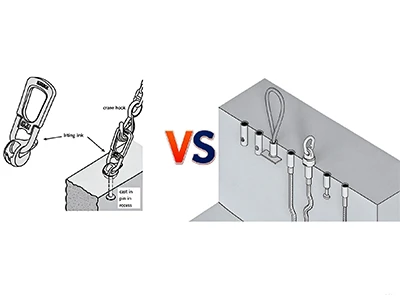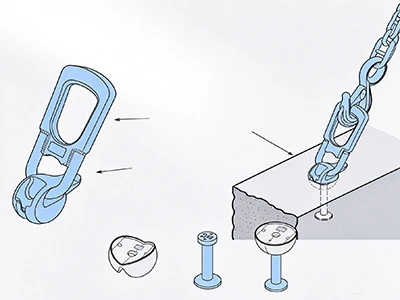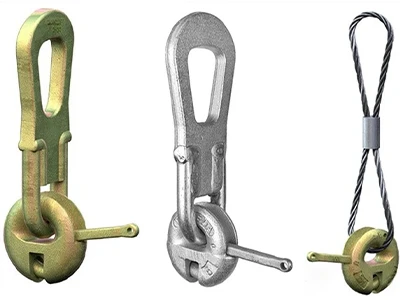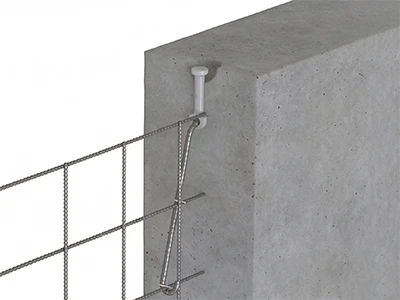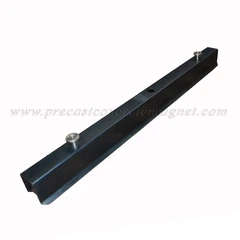
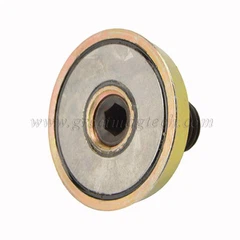


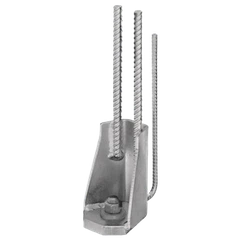
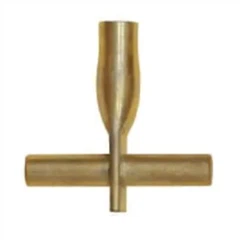

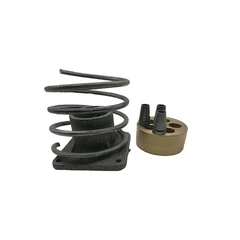

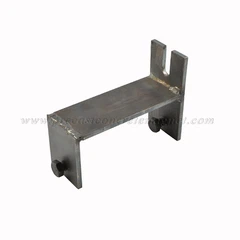
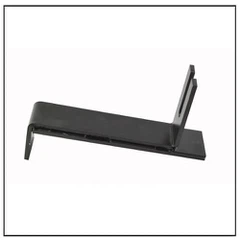


A single wire rope loop box is a cast-in lifting insert that provides a secure, temporary lifting point for precast concrete elements. You position the box and its steel wire rope loop in the formwork before pouring, leaving the loop accessible once the concrete has achieved the specified lifting strength. Your team can use it to demould, turn, move, or load suitable wall panels, slabs, and custom units. You can choose this system when you need a practical, integrated lifting solution that supports efficient handling while following design requirements.
What Are the Main Parts of a Wire Rope Loop Box?
To understand this system, you should know how each component supports a reliable, inspectable precast wall-panel joint at every stage of the project.
Steel Box or Protective Casing
You use the steel box to protect the loop during casting, storage, transport, and panel erection.
High-Strength Wire-Rope Loop
You rely on the high-strength wire-rope loop to transfer design forces across the approved joint connection.
Recess Former
The recess former creates access while the protective cover shields the loop; you remove it before assembly.
Connecting or Locking Bar
You insert the specified connecting or locking bar through overlapping loops to secure adjacent panels in position.
Specified Joint Grout
You fill the joint with approved grout to surround the connection, restore continuity, and protect embedded steel.
Panel-Edge Reinforcement
You need panel-edge reinforcement around the insert to distribute forces into concrete and reduce local cracking.

How Does a Single Wire Rope Loop Box Work?
A single wire rope loop box connects precast concrete wall panels to create the intended mechanical connection. During production, you position each box according to the shop drawing and reinforcement detail. After erection, you remove the cover and open the wire-rope loop. You then overlap loops from neighboring panels and insert the connecting bar. After checking alignment, you fill the joint with approved grout. You should follow the project's structural details and never use the loop as a lifting anchor during panel handling or lifting operations.
What Is It Used for in Precast Concrete Production?
In your precast concrete production line, a single wire rope loop box can provide a practical lifting point for common products and handling stages:
1. Precast Wall Panels: Use it to demould panels and move them between casting beds, storage areas, and trucks.
2. Slabs and Facade Elements: Lift suitable slabs, cladding panels, and architectural units when the insert position and load capacity match your design.
3. Stair Units and Customized Components: Use it in stairs, beams, small frames, and other engineered shapes requiring temporary lifting points.
4. Handling Operations: Use the loop for demoulding, tilting, yard handling, and loading, provided the concrete has reached the specified strength and your lifting equipment is compatible.

Single vs. Double Wire Rope Loop Box: What Is the Difference?
When comparing single and double wire rope loop boxes, you should consider loop arrangement, installation space, and verified design performance rather than simply counting the loops.
|
Comparison Point |
Single Wire Rope Loop Box |
|
|
Loop arrangement |
One wire-rope loop per box |
Two loops or a paired-loop arrangement, depending on the manufacturer |
|
Typical application |
Standard precast wall-panel joints |
Joints requiring additional connection points or project-specific detailing |
|
Installation space |
Usually creates less congestion |
May require more space and closer coordination with reinforcement |
|
Connection capacity |
Must be confirmed from tested product data |
Does not automatically provide twice the capacity |
|
Selection factors |
Joint forces, panel thickness, spacing, and reinforcement |
The same factors, plus loop arrangement and spacing |
|
Required documents |
Product drawing, test data, and installation instructions |
Product drawing, test data, bar requirements, and installation instructions |


How to Choose the Right Single Wire Rope Loop Box
Choosing the right single wire rope loop box requires you to match the product to the precast element, joint design, and required structural performance rather than selecting only by size or price.
Check the Precast Wall Thickness
Confirm that the box dimensions fit within the wall while maintaining the required concrete cover and avoiding interference with reinforcement.

Confirm the Joint Width
Joint width affects loop projection, reinforcement arrangement, and the final grouted connection. You should check it against the project drawing before selecting a model.
Select the Required Loop Length
Choose the loop length according to the joint geometry and connection design. Common sizes may include 80, 100, 120, or 140 mm, depending on the system.
Check the Required Load Transfer
Determine whether the connection needs to transfer shear, tensile forces, or combined loads. Always refer to tested product data and engineering calculations.
Confirm Loop Spacing and Edge Distance
Correct spacing helps ensure the joint performs as designed. Avoid copying spacing from another project without verification.
Check Reinforcement and Grout Requirements
Review the required vertical reinforcement, joint rebar, and grout specification as part of the complete connection system.
Review the Manufacturer's Technical Data
Before ordering, check dimensions, materials, tested resistance, installation requirements, and available technical drawings to confirm the loop box matches your project.
Common Mistakes When Choosing a Single Wire Rope Loop Box
Avoiding common selection mistakes can help you prevent installation problems, unsuitable joint performance, and unnecessary project delays.
Choosing Only by Loop Length
Loop length is important, but you should also consider joint width, wall thickness, reinforcement, and required load transfer.
Ignoring Wall Thickness
A loop box that is too large for the precast element may interfere with reinforcement or reduce the required concrete cover.
Copying Spacing From Another Project
Loop spacing should follow your current joint design. Different wall dimensions, loads, and reinforcement layouts may require different spacing.
Comparing Only Wire Rope Diameter
A thicker wire rope does not automatically mean a stronger connection. Box design, anchorage, materials, and testing also affect performance.
Using Another Manufacturer's Load Data
Do not apply one supplier's load data to another product unless the specifications and test conditions are verified.
Confusing Connection Loops With Lifting Anchors
Wire rope loop boxes are designed for precast connections, not for lifting concrete elements.
Conclusion
A single wire rope loop box can simplify your precast wall connections when you select and install it according to the structural design. Before ordering, you should confirm panel geometry, reinforcement, loop spacing, joint width, exposure conditions, and grout compatibility. You should also request drawings, test data, installation guidance, and traceable quality records. If you need a dependable supplier for your precast project, contact GEM directly. Send us your joint drawing, panel thickness, required specifications, quantity, and destination, and our team will recommend a suitable solution and prepare a quotation.
FAQ
Q: Is a single wire rope loop box a lifting anchor?
A: No. It is designed for connecting precast concrete elements, not for lifting, hoisting, or handling panels. Use approved lifting anchors for those operations.
Q: What does single mean in a wire rope loop box?
A: Single means each box contains one wire rope loop. It does not describe the number of boxes used in a joint.
Q: How is the load capacity determined?
A: Capacity depends on the wire rope, anchorage sleeve, box design, concrete strength, edge distance, reinforcement, joint grout, and load direction. Your engineer should use tested data and project calculations rather than a generic rating.
Q: Can it be used in thin precast wall panels?
A: It may be suitable if the box dimensions, concrete cover, edge distance, reinforcement, and joint width meet the approved design. Always confirm the minimum panel thickness with the supplier and engineer.
Q: What connecting bar is required?
A: Use the specified diameter, steel grade, length, and insertion arrangement shown on the connection drawings. Do not substitute a bar without engineering approval.