




Did you know that the global prestressed concrete market is expected to surpass $45 billion by 2030? It's incredible-and corrugated ducts play a huge, often-overlooked role in making these structures safe, durable, and long-lasting!
When I first learned about prestressed systems, I was amazed at how something as simple as a duct could make or break the entire structural performance. In this guide, we'll dive deep into what corrugated ducts do, why they matter, and how they ensure successful post-tensioning and prestressed concrete construction. Whether you're an engineer, contractor, or precast manufacturer, understanding this component is essential!
What Are Corrugated Ducts in Prestressed Concrete?
A corrugated duct is a hollow tube with a ribbed (corrugated) profile. It is commonly used in prestressed concrete and post-tensioned concrete systems as a protective conduit to house steel strands or prestressing tendons. Its main function is to provide a continuous and secure passage for the prestressed steel strands so that they can be effectively tensioned after the concrete is poured. It is commonly used in prestressed bridges, box girders, prestressed slabs in buildings and parking lots, large beams and trusses, precast wall panels, hollow slabs, and industrial floors.
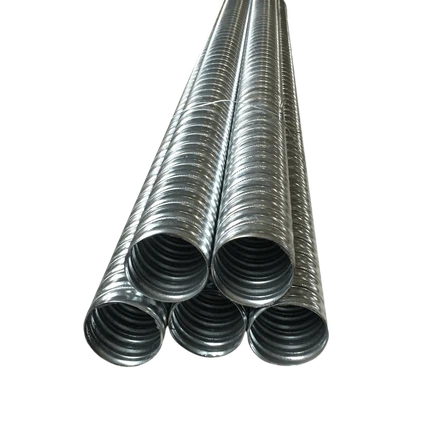
Functions and Importance of Corrugated Ducts
Corrugated dusts play a crucial role in the performance, durability, and safety of prestressed concrete and post-tensioned concrete systems. Their design, material selection, and placement directly affect the efficiency of rebar tensioning and protection throughout the structure's entire service life.
1. Preventing Rebar Corrosion
Corrugated Ducts act as a barrier between the rebar and the surrounding concrete. They prevent moisture, chlorides, and corrosive chemicals from contacting the rebar. With proper grouting, corrugated Ducts form a sealed protective system, significantly extending the service life of the rebar.
2. Providing a Controllable Path for Post-Tensioned Rebar
Ensuring smooth movement of the rebar along the designed profile (straight, vertical, or curved). Preventing rebar abrasion during installation and tensioning. Making rebar performance predictable during jacking and load transfer.
3. Complete Grout Encapsulation of Steel Strands
The internal space allows the grout to flow and fill all voids. Supporting long-term anchorage of the steel strands by forming a strong bond between the grout and the rebar.
4. Maintain Precise Strand Alignment
Keep the steel strands in the precise geometric position required by the design. Ensure the correct eccentricity required for prestressing. Reduce frictional losses due to unplanned deviations or sharp bends.
5. Improve Structural Durability and Load-Bearing Capacity
Properly grouted ducts improve structural stiffness and crack control. Enhance the reliability of prestressed beams, slabs, and trusses.
Types of Corrugated Ducts Used in Prestressed Concrete
|
Property |
HDPE Corrugated Duct |
Metal Corrugated Duct (Galvanized Steel) |
Aluminum Corrugated Duct |
|
Corrosion Resistance |
Excellent |
Good (risk increases if the zinc coating is damaged) |
Moderate |
|
Strength / Stiffness |
Moderate |
High |
Low |
|
Flexibility |
High |
Moderate |
High |
|
Friction Loss |
Low (smooth inner surface) |
Higher |
Low |
|
Weight |
Light |
Heavy |
Very light |
|
Fire Resistance |
Poor (melts under high temperature) |
Excellent |
Poor (melts under high temperature) |
|
Cost |
Medium |
Most economical |
High |
|
Main Applications |
Marine structures, water-related projects, corrosive environments |
Industrial & civil structures, inland bridges |
Largely phased out; not recommended |
How Corrugated Ducts Work in Prestressing Systems
Arrangement of Reinforcing Steel within the Corrugated Ducts
Before pouring concrete, steel strands or reinforcing bars are passed through the corrugated Duct. The corrugated Duct provides a protected channel, allowing the reinforcing bars to maintain their geometry along straight or curved lines. Proper support prevents sagging, misalignment, and wear during tensioning.
Influence of Corrugated Duct Shape on Friction
The corrugated shape improves mechanical stability while minimizing unintended deformation. A smooth inner surface (especially in high-density polyethylene (HDPE) corrugated Ducts) reduces friction between the reinforcing bars and the corrugated Duct wall during tensioning.
Role in Post-Tensioning (Lifting Method)
The duct restricts the movement of the reinforcing bars, allowing them to be controlled during tensioning at the anchor points. It ensures the reinforcing bars move according to the designed eccentricity, thus providing the required compressive force. It prevents the reinforcing bars from contacting the newly poured concrete, thereby maintaining structural safety.
Ensuring Grout Bond
After tensioning, grout is injected into the duct, encasing the reinforcing bars. The corrugated outer wall enhances the mechanical interlocking between the grout and the surrounding concrete.
Good adhesion enhances anchorage transfer, stiffness, and crack resistance.
Preventing voids and ensuring grout flow. The Duct diameter and smooth inner wall ensure free flow of the grout, preventing blockages. A carefully designed system prevents cavitation, which can lead to corrosion. Compatible with standard grout pumps and pressure injection systems. The corrugated Duct ensures that the reinforcing steel remains protected, properly aligned, and fully bonded, providing reliable prestressing performance in bridges, slabs, beams, and other structural members.

Common Issues and Troubleshooting in Corrugated Duct Installation
Installation
Proper installation of corrugated Ducts is crucial for ensuring reliable post-tensioned performance. Improper Duct handling can lead to problems such as grout leakage, deformation, and misalignment, which can compromise reinforcement protection and structural durability.
Grout Leakage
Causes: Poor joint sealing, damaged duct sections, or improper connector installation.
Prevention/Solution: Use high-quality connectors and sealing tape specifically designed for prestressed systems. Inspect all joints before pouring concrete. Perform pressure testing on critical structural Ducts if necessary.
Pipe Collapse Under Vibration
Causes: Insufficient stiffness, excessive compaction energy, or improper support spacing.
Prevention/Solution: Use galvanized metal ducts or thick-walled high-density polyethylene (HDPE) ducts in high-vibration areas. Add duct supports and gaskets to maintain duct shape. Avoid pouring concrete directly onto unsupported ducts.
Loose Connections or Insufficient Strength
Causes: Loose duct ends, poor-quality connectors, or duct movement during concrete pouring.
Prevention/Solution: Securely fasten connections using approved prestressed (PT) fittings. Re-inspect anchorage areas under maximum pressure. For long ducts, use mechanical connectors instead of tape connections.
Excessive Friction Loss Due to Misalignment
Causes: Duct displacement during pouring, improper layout planning, or excessive bending.
Prevention/Solution: Securely fasten ducts to supports or reinforcing bars, maintaining adequate spacing. Follow design curvature limits and avoid sharp bends. Always check alignment before pouring concrete and after initial vibration.
Applications of Corrugated Ducts in Modern Construction

Applications of Corrugated Ducts in Modern Construction: Corrugated Ducts are widely used in modern prestressed concrete and post-tensioned concrete systems to provide a safe passage for reinforcing steel and ensure the long-term performance of the structure. Their versatility allows for integration into precast and cast-in-place structures, supporting a wide range of structural applications.
1. Bridges (including box girders): Used to guide reinforcing steel along curved or suspended profiles within the box girder. Crucial for distributing prestress over long spans. Protects reinforcing steel from exposure to harsh weather and heavy loads.
2. Post-tensioned Slabs: Commonly found in high-rise buildings, parking lots, and commercial floors. Corrugated Ducts allow reinforcing steel to run long distances with minimal frictional loss. Increases the load-bearing capacity of the slab while reducing the overall thickness of the concrete.
3. Prestressed Beams and Trusses: Maintains the alignment of prestressed tendons in beams with high flexural strength. Reduces cracking and deflection under service loads. Achieves efficient load transfer by controlling eccentricity.
4. Precast Hollow Slabs: Pipes allow for the precise positioning of prestressed steel strands within precast slab segments. Increase the speed and efficiency of large production lines. Ensure consistent performance of repetitive structural components.
5. Subway tunnels and underground engineering: Used for segmented tunnel lining requiring prestressing to resist earth pressure. HDPE ducts provide corrosion protection in humid and corrosive environments.
Industrial floors and heavy-duty structures: Enable post-tensioned design to resist cracking under forklift or mechanical loads. Improves the long-term durability of factories and logistics centers.
How to Choose the Right Corrugated Duct for Your Project
Choosing the right corrugated duct is crucial for ensuring the protection, long-term durability, and reliable prestressing performance of the prestressing tendons. Each project has its own environmental, structural, and installation requirements.
Environmental Conditions
Marine, coastal, or chloride-rich environments: High-density polyethylene (HDPE) duct offers excellent corrosion resistance and long-term durability.
Dry inland areas or general building structures: Galvanized metal pipe provides reliable strength for standard prestressed applications.
Required Type and Number of Prestressing Tendons
Larger prestressing tendon bundles or multiple strands require pipes with higher stiffness and larger inner diameters.
Bent prestressing tendons can benefit from using flexible HDPE pipe to reduce friction and prevent kinking.
Straight profiles in beams or trusses can use metal ducts to enhance stability.
Budget Considerations
Metal ducts are often the most economical choice for large industrial projects.
High-density polyethylene (HDPE) ducts offer both cost and performance advantages, especially suitable for corrosive environments.
Aluminum ducts are more expensive and less strong, so they are rarely used in large prestressed systems.
Installation Complexity
Projects with significant curvature or long prestressing tendon paths require more flexible ducts.
Prefabricated duct sections use robust connectors, reducing on-site work and speeding up installation.
Due to the weight of metal ducts, more manual handling may be required.
Conclusion
Corrugated ducts may seem like a small part of prestressed concrete, but they play a massive role in ensuring safety, durability, and structural performance. From providing a secure path for tendons to offering corrosion protection and ensuring proper grout bonding, these ducts are the backbone of every successful post-tensioning system.
FAQ
Q: 1. What are corrugated ducts used for in prestressed concrete?
A: Corrugated ducts create a protected pathway for steel tendons in post-tensioned and prestressed concrete systems. They maintain tendon alignment, reduce friction loss, and allow grouting to fully encapsulate the strands after stressing.
Q: 2. What materials are corrugated ducts made from?
A: Common materials include HDPE, galvanized steel, and aluminum.
HDPE: corrosion-resistant and flexible
Metal: high strength and rigidity
Aluminum: lightweight but less commonly used
Q: 3. Which type of duct is best for marine or corrosive environments?
A: HDPE corrugated ducts are preferred due to their excellent resistance to moisture, chlorides, and aggressive environmental conditions.
Q: 4. Why are ducts corrugated instead of smooth?
A: The corrugated exterior enhances mechanical interlock with the surrounding concrete and improves stiffness. Internally, smoother surfaces reduce friction during tendon stressing.
Q: 5. Can corrugated ducts be used for curved tendon profiles?
A: Yes. HDPE ducts are especially suitable for curved or draped tendon paths because of their superior flexibility.
Q: 6. How are ducts connected and sealed?
A: Ducts are connected using mechanical couplers, clamps, or sealing tapes. Proper sealing prevents grout leakage and ensures full encapsulation of the tendons.
Q: 7. How do corrugated ducts prevent tendon corrosion?
A: Once stressed, the ducts are injected with cement grout. This grout fills all voids and forms a protective bond around the steel strands, preventing water or air infiltration.
Q: 8. What causes grout leakage, and how can it be avoided?
A: Leakage typically results from poor joint sealing or damaged duct sections. Using high-quality couplers, pressure-rated sealing tape, and proper installation techniques eliminates this risk.
Q: 9. Can corrugated ducts collapse during concrete vibration?
A: If unsupported or made from thin materials, ducts may deform under heavy vibration. Galvanized steel ducts and thick-wall HDPE ducts offer higher resistance to collapse.
Q: 10. Are corrugated ducts compatible with standard PT equipment?
A: Yes. Most ducts are designed to work with commonly used grouting pumps, pressure injection systems, and anchorage fittings in the PT industry.