






Post-tensioning is an innovative technology in modern bridge construction. It allows designers to create iconic structures that are rock solid, durable, and beautiful.
We'll discuss post-tensioning in general-how it is supposed to function, its myriad benefits, actual applications, and finally, what the future holds for even more advancements.
What is Post-Tensioning for Bridges
Prestressing of concrete elements by tensioning steel (cables, tendons) after concrete solidification. The tensioned cables balance compressive forces induced by external loads.
This clever technique started on the desks of project design engineers in the 1950s and has been a cornerstone in the building of concrete bridge infrastructure ever since. Optimized structural performance, longer spans, or faster construction are made possible through it.
Post-tensioning concretely reinforces bridge structures increasing their safety, durability, and their load carrying capacity. It also lets us build slender, elegant designs that would otherwise be impossible with traditional construction means.
Key Terminology
Some key terms worth knowing:
Prestressing: Application of internal stresses to counteract future loads
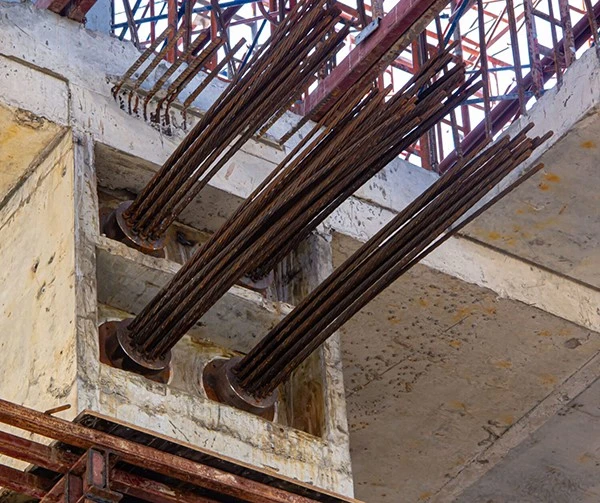
Tendons: High-strength steel cables used for post-tensioning
Ducts: Protective sleeves housing the steel tendons
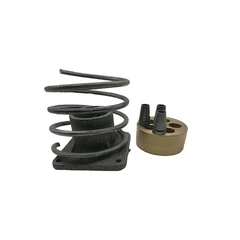
Anchors: Mechanisms to grip and fix the stressed tendons
Grouting: Filling ducts with cement to shield tendons
How is Post-Tensioning Used in Bridges
Post-tensioning allows efficient and optimized use of concrete in bridge construction. It imparts durability, resilience, and added strength through compressive prestressing of structural members. But how exactly is this technique employed in bridges?
Tendon Layout and Duct Placement
Post-tensioning tendons, comprising high-strength steel strands or bars, are laid out in ducts within concrete girders, beams, decks, piers,s and other bridge elements per engineered design requirements. Tendon profiles are meticulously mapped to counteract bending moments from anticipated loads. Duct placement may be within the concrete or alone on the edges and faces of structural members.
Tensioning and Anchoring Tendons
After the concrete is cast and cured, controlled tensioning of the tendons commences using hydraulic jacks. Tensioning may occur from anchorages at beam ends or through intermediate deviators along the span. Jacking elongates the steel and generates a compression force along the concrete surrounding the ducts.
Wedge-type anchoring grips are activated following tensioning to lock each tendon at a precise force. These high-strength steel anchors permanently secure the cables and maintain compression in the concrete. Any unused length of tensioned cable is cut off beyond the anchors.
Grouting the Ducts
The final step is filling ducts with high-strength, non-shrink grout. This protective cement fills voids, bonds tendons to concrete, prevents corrosion, and provides rigidity. Owing to durable encapsulation, post-tensioning remains effective for the life of the bridge.
Continuous and Balanced Post-Tensioning
Inbox girder and T-beam superstructures, tendons thread continuously through the entire bridge or individual spans to enable optimal prestressing. Balanced cantilever construction leverages simultaneous tensioning from opposite ends.
Segmental Bridge Construction
For segmental construction, ducts align through discrete conjoined units.
Thus through thoughtful layout, tensioning, and protection of tendons, post-tensioning allows efficient use of concrete - enhancing a bridge's resilience and extending its life through active compression against environmental stressors and extreme live loads.
Advantages of Using Post-Tensioning in Bridges
Post-tensioning provides immense benefits that make it the preferred technique for modern bridge construction projects.
Withstands Heavy Traffic
The high level of prestressing enables bridge structures to safely withstand and bear vehicular loads that exceed the legal limits of normal infrastructure. Post-tensioned bridges have enhanced load-bearing strengths and can cope with the demands of heavy traffic volumes without the need for frequent upgrades or strengthening. This makes their lifespan notably longer under intense traffic conditions.
Resists Cracking and Damage
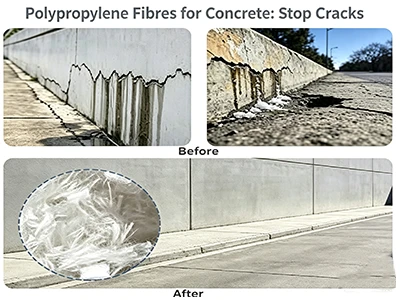
The compressive force generated by post-tensioning provides an innate resilience that makes bridges significantly less susceptible to cracking, buckling, and weathering deterioration issues over decades of operational use. By countering stresses and strains induced by dynamic loading and environmental factors, post-tensioned bridges can withstand seismic events, typhoons, and intense storms as well as daily traffic, and continue functioning safely with minimal maintenance needs.
Allows Creative Long Spans and Slender Designs
An area where post-tensioning truly shines is enabling gracefully long bridge spans ranging from 100 feet to even 500 feet. This vast expansion in possible span length has opened up new avenues for creative, signature bridge designs that can serve as iconic architectural landmarks. Post-tensioning gives structural engineers greater liberty to explore slender, elegant superstructures with easier acceleration and deceleration for approaching vehicles.
Uses Less Material Compared to Traditional Bridges
By significantly enhancing the structural efficiency of bridges, post-tensioning allows optimized material usage during construction. Lighter, thinner bridge decks and longer spans between supports mean that substantially less concrete and steel rebar reinforcement is necessary compared to conventionally built bridges of the same size. With resource optimization directly translating into cost savings, this is what makes post-tensioning a financially prudent technique.
Smaller Carbon Footprint – Environmentally Sustainable
With its resource optimization, rapid construction capabilities, and extended operational lifespan, post-tensioning is deemed a sustainable, environmentally friendly construction technique. Leveraging accelerated bridge construction methods to minimize traffic impacts also reduces emissions from idling vehicles. By using fewer raw materials to achieve more, post-tensioning reduces the carbon footprint of bridges, which is vital for meeting green building regulations.
Applications and Examples of Post-Tensioned Bridges
Post-tensioning has been employed in every major modern bridge type, including:
Box Girder Bridges
This common bridge variety utilizes post-tensioned box girders for the superstructure. The box shape and prestressing enable large spans.
Cable-Stayed Bridges
These dramatic bridges use post-tensioned concrete towers and decks flanking the cable stays. The cables transmit loads to the anchors.
Arch Bridges
Post-tensioning allows for the efficient design of these aesthetically pleasing bridge types. It's used in tied arches, Nielsen arches, and more.
Some real-world examples of iconic post-tensioned bridges include:
Millau Viaduct, France: Its streamlined design has seven post-tensioned towers soaring 1000 ft to support the world's tallest bridge deck.
Sunshine Skyway Bridge, USA This cable-stayed girder bridge with post-tensioning withstands hurricane winds and ship collisions.
Confederation Bridge, Canada: Spanning 8 miles over water, post-tensioning handles severe maritime weathering for this record-breaking structure.
Bill Emerson Memorial Bridge, USA: its main span has post-tensioned cast-in-place concrete girders to achieve a record 1500 ft length.
Bandra-Worli Sea Link, India: Mmbai's iconic cable-stayed bridge has post-tensioned viaducts on either side, optimizing materials.
These landmarks illustrate the power and flexibility of post-tensioning in bridge engineering.
Construction and Analysis of a Post-Tensioned Bridge
Let's look at some key aspects of constructing and analyzing post-tensioned bridges:
Construction Sequences
Engineers detail sequential construction steps, coordinating temporary supports, staged concreting, closing pours, and tensioning duct layouts.
Finite Element Modeling
Advanced software digitally simulates staging, structural behavior, post-tensioning, and construction loads for optimization.
Flexural and Shear Capacity Checks
The design undergoes extensive evaluation using codified calculations and computer models.
Ultimate Limit State Checks
The bridge's capacity to withstand maximum loads within safety margins is thoroughly assessed.
Comparison of Analysis Methods
Results from manual computation and modeling tools are cross-verified for failsafe evaluation.
Ongoing analysis and checks ensure the bridge performs safely for its entire service life.
Future Innovations in Post-Tensioned Bridges
As an ever-evolving technique, post-tensioning has exciting innovations on the horizon that will further elevate its capabilities and advantages. One area of focus is enhancing the durability of post-tensioned structures through materials science advancements. Special protective coatings, stainless steel grades, and corrosion-resistant alloys are being developed to provide permanent shielding against harsh environments. Integrated digital design platforms also hold great promise for optimizing and automating the analysis, modeling, and design of post-tensioned bridges. These smart systems will leverage automation and artificial intelligence to create highly tuned designs that match project goals.
Additionally, sustainability is an increasing priority for future advancement. Greener, recycled materials and construction practices will minimize the ecological impact of building post-tensioned bridges.
With over 60 years of proven success already fundamentally transforming the infrastructure landscape, post-tensioning will continue scaling to new heights in the decades ahead through continual engineering creativity. Revolutionary material science, digital tools, and sustainability focus will usher in the next era of cutting-edge, high-efficiency post-tensioned bridge engineering.