




1. Specification Perspective
1.1 Design specifications
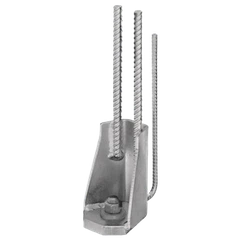
Embedded parts: In the early stage of engineering design such as buildings and machinery, embedded parts are included in the overall planning. The design drawings will accurately mark their specifications, materials, positions, and anchoring methods. For example, the crane beams of large industrial plants are designed with embedded parts in mind to ensure the subsequent accurate installation of cranes, stable load bearing, accurate calculations, and strict control of safety factors.
Several aspects of embedded parts that need attention:

Post-embedded parts: Often used in existing building renovation and decoration projects. When designing, it is necessary to conduct on-site inspections of existing structural conditions and then design them in a targeted manner. Due to the limitations of on-site conditions, the specifications are more flexible and mostly follow the "Technical Regulations for Post-Anchorage of Concrete Structures", paying more attention to the existing structure load verification and the reliability of post-embedded parts connections.
Post-embedded parts inevitably involve mechanical anchor bolts and chemical anchor bolts. The application scenarios of the two anchor bolts are summarized as follows:
Mechanical anchor bolts:
Structures with high load requirements: Suitable for occasions with high requirements for load-bearing capacity and stability, such as bridges and the fixing of large machinery and equipment. Its metal material and mechanical lock key principle enable it to withstand large tension, pressure, and shear force.
Complex geology and harsh environment: It can be used for various complex geological conditions and harsh engineering environments, such as the reinforcement of building structures in earthquake-prone areas and strong wind areas. Its high-temperature resistance, aging resistance, fatigue resistance, and other properties can ensure long-term stability.
Small margin and small spacing installation: The expansion stress is small, which is suitable for installation and fixing under the conditions of small margins and small spacing, such as building curtain walls and equipment foundations with limited space.
Positions that require later welding: It is weldable and suitable for parts that need to be welded on anchor bolts, such as some steel structure connections and places where further reinforcement welding is required after equipment installation.
1.2. Quality Acceptance Specifications
- Embedded parts: The acceptance process is synchronized with the main structure. As part of the structure, it requires high quality in one-time molding. The acceptance standards for indicators such as the anchor length of the steel bar, welding quality, and the deviation of the embedded position are accurate and strict, and the deviation is usually controlled at the millimeter level.
- Post-embedded parts: In addition to the routine appearance and size inspection, the pull-out test results of the post-embedded anchor bolts are focused on to ensure that the anchoring force meets the standard. The implantation depth and spacing must also be checked. The acceptance standards are relatively wide, but the key indicators must meet safety requirements.
2. The Actual Application Angle Of The Project
2.1. Construction Process
- Embedded parts: The installation and positioning are completed before the concrete is poured, and they are tied and fixed together with the steel skeleton. They are vibrated and compacted during pouring and are formed into the structure at one time. The construction rhythm is compact and orderly, and no secondary operation is required. However, the accuracy requirements for the preliminary preparation are extremely high, and mistakes are difficult to correct.
- Post-embedded parts: It is necessary to drill and clean holes on the existing structure first, implant anchor bolts or install expansion bolts before fixing the embedded plate. The construction steps are cumbersome, the working surface is small, and it is also limited by on-site water, electricity, and space. The construction progress is slow, but it is relatively easy to adjust when the design changes.
2.2. Cost And Construction Period
- Embedded parts: The initial procurement, production, and installation costs are concentrated. Because they are synchronized with the main structure, the overall construction period does not increase additionally. It is suitable for new large-scale projects and has good long-term comprehensive cost-effectiveness.
- Post-embedded parts: The material cost is slightly higher due to single-piece procurement, special anchor bolts, etc., and the labor time is long, the construction period is extended, and it has advantages in the small-scale renovation, emergency repair, and other projects, and the short-term input-output is more flexible.
2.3. Reliability
- Embedded parts: It has good synergistic force performance with concrete and good durability. As long as the initial construction is correct, there is rarely loosening or displacement, and the service life is equivalent to the main structure.
- Post-embedded parts: rely on anchor bolts to bond and rub against the existing structure, are greatly affected by construction technology, ambient temperature, and humidity, have slightly lower long-term reliability, and require regular inspection and maintenance.