




Introduction
In the production of precast concrete, chamfer strips may appear to be a minor detail; however, they directly impact the edge-forming quality of components, production efficiency, and overall consistency. The choice between magnetic and rubber chamfer strips is not merely a decision regarding material composition; rather, it reflects the organizational structure of the production line as well as the time costs incurred during the tooling preparation phase.
Magnetic chamfer strips offer the distinct advantages of rapid positioning and repeatable, high-precision performance, whereas rubber chamfer strips excel in flexibility-capable of accommodating irregularly shaped components while requiring a relatively lower initial investment. A thorough understanding of the differences between these two solutions enables manufacturers to strike the optimal balance among efficiency, durability, and cost.
What Is a Magnetic Chamfer?
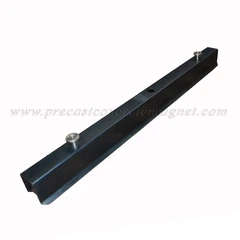
The magnetic chamfer is a specialized formwork accessory used in precast concrete production to create clean and consistent beveled edges on concrete elements. Its core structure consists of a steel chamfer embedded with high-strength magnets, designed to attach directly to steel formwork without the need for screws, welding, or other fixing methods.

Structure and Working Principle
The steel body provides excellent durability and dimensional stability, while the built-in magnets generate a strong holding force on the formwork surface. Once positioned, the chamfer remains firmly in place, even during vibration and concrete pouring, ensuring reliable performance throughout the production process.
Advantages of Magnetic Chamfer
Magnetic chamfers simplify the formwork installation process while improving consistency across different production batches. By attaching directly to steel molds, they eliminate the need for drilling, screws, or welding. This significantly reduces installation time while preserving the integrity of the working surface. As a result, setup becomes faster, cleaner, and easier to adjust when layout changes are required.
Secure and Reliable Fixatio
Built-in magnets provide a strong holding force, ensuring the chamfer remains firmly in place during vibration and concrete pouring. This high level of stability effectively reduces the risk of movement, helping maintain precise positioning and minimizing the need for rework.
Reusability and Cost Efficiency
Magnetic chamfers are designed for repeated use and can withstand multiple casting cycles without loss of performance. Although the initial purchase cost may be slightly higher than traditional options, their durability and reduced labor requirements make them more cost-effective over the long term.
Consistent Edge Quality
A firmly fixed and accurately positioned chamfer ensures that each concrete element is formed with clean and uniform edges. This not only enhances the final appearance of the product but also reduces the need for additional finishing work on site.
What Is a Rubber Chamfer?
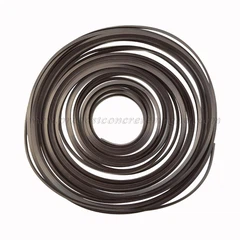
A rubber chamfer is a flexible formwork accessory used in precast concrete production to create beveled edges on concrete elements. It is made from rubber or similar elastic materials and is designed to shape edges while adapting to different mold conditions.

Structure and Material Characteristics
Rubber chamfers are lightweight and easy to handle. Their soft material makes them especially suitable for applications that require minor adjustments during installation. However, this same flexibility may lead to deformation over time, particularly under repeated use or in high-vibration environments.
Practical Applications in Construction
Rubber chamfers are typically fixed using adhesives, nails, or mechanical methods. They are commonly used in small-scale projects or custom molds where flexibility is prioritized over installation speed. However, due to their relatively shorter lifespan and lower stability, they are less suitable for large-scale precast concrete production that demands high efficiency and consistency.
Advantages of Rubber Chamfer

Rubber chamfers remain a practical choice in many precast applications, especially in scenarios where flexibility and cost control are top priorities.
Cost Efficiency
One of the main advantages is the lower initial investment. Rubber chamfers are typically more affordable upfront, making them well-suited for small-scale projects, temporary setups, or operations with limited budgets. For short production runs, this cost advantage becomes particularly noticeable.
Flexibility for Custom Applications
The rubber material provides excellent adaptability, allowing the chamfer to conform to irregular shapes and non-standard formwork. This makes it a practical solution for customized or complex designs where rigid chamfers may not fit easily.
Ease of Operation
Rubber chamfers are lightweight and easy to handle, reducing labor effort during installation and removal. Their lightweight makes manual operation and on-site adjustments more convenient, especially in production environments with lower levels of automation.
Key Differences Between Magnetic Chamfer and Rubber Chamfer
|
Comparison Factor |
Magnetic Chamfer |
Rubber Chamfer |
|
Fixing Method |
Magnetic attachment, no tools required |
Gluing, nailing, or manual fixing |
|
Installation Speed |
Very fast, place, and use |
Slower, requires manual setup |
|
Labor Requirement |
Low labor, suitable for automation |
Higher labor involvement |
|
Positioning Accuracy |
High precision, consistent results |
Lower accuracy, may shift |
|
Durability |
Long-lasting, reusable |
Limited lifespan, prone to wear |
|
Reusability |
High, suitable for mass production |
Limited reuse |
|
Flexibility |
Rigid, best for standard shapes |
Highly flexible, fits irregular shapes |
|
Surface Finish |
Clean and uniform edges |
Depends on installation quality |
|
Best Application |
Large-scale precast production |
Small or custom projects |
When to Choose a Magnetic Chamfer vs Rubber Chamfer
Choosing between a magnetic chamfer and a rubber chamfer depends on how your production operates. The right decision should consider production scale, efficiency requirements, and the level of precision needed for the final concrete elements.
For Large-Scale and Repetitive Production
Magnetic chamfers are better suited for factories running continuous, high-volume production. They attach instantly to steel formwork, allowing fast installation and easy repositioning without tools. This reduces labor time and improves workflow consistency. In environments where hundreds of components are produced regularly, even small time savings per setup can translate into significant efficiency gains.
For Temporary or Custom Applications
Rubber chamfers provide flexibility when standardization is not feasible. For irregular shapes, small production runs, or one-time molds, their adaptability becomes a clear advantage. Compared to rigid magnetic systems, rubber chamfers are easier to cut, adjust, and fit onto non-standard surfaces.
Balancing Cost and Performance
Material cost alone does not reflect the full picture. Magnetic chamfers require a higher initial investment but reduce labor costs and replacement frequency over time. In contrast, rubber chamfers may have a lower upfront cost but often involve more manual work and a shorter service life.
Precision and Surface Finish
For projects requiring clean, consistent edges and tight tolerances, magnetic chamfers provide more reliable positioning accuracy. While rubber chamfers can achieve acceptable results, the consistency of the finished edges largely depends on the precision of manual installation.


Conclusion
Although magnetic and rubber chamfer strips serve the same purpose, they exhibit significant differences in performance within actual production environments. Magnetic chamfer strips are characterized by high speed, high precision, and superior long-term cost-effectiveness, whereas rubber chamfer strips excel in terms of flexibility and low initial investment costs. The ultimate choice between these two options depends on specific factors such as production scale, budgetary constraints, and performance requirements.
FAQ
Q: Are magnetic chamfer strips suitable for all steel formwork?
A: Magnetic chamfer strips require the steel formwork to have sufficient thickness to ensure adequate magnetic adhesion. If the steel plate is too thin, the magnetic effect may be diminished. Furthermore, the contact surface must be kept clean and flat to ensure optimal performance.
Q: Can rubber chamfer strips be reused?
A: Rubber chamfer strips can be reused to a certain extent; however, their service life is typically shorter. Over time, repeated use, vibration, and the compressive pressure from the concrete may cause them to deform or sustain damage.
Q: What is the service life of magnetic chamfer strips?
A: Magnetic chamfer strips are specifically designed for long-term, repeated use. With proper handling and maintenance, they can be used hundreds or even thousands of times, offering greater cost-effectiveness in the long run.
Q: Is the installation of magnetic chamfer strips faster than that of rubber chamfer strips?
A: Yes. Magnetic chamfer strips adhere directly to the steel formwork without the need for any tools, thereby significantly reducing installation time. In mass production environments, this can result in substantial savings on labor costs.
Q: Does the magnetic force of chamfer strips weaken over time?
A: High-quality magnetic chamfer strips typically maintain stable magnetic performance over a long period. However, exposure to extreme heat, physical impact, or improper storage methods may adversely affect the magnets' strength.
Q: Are magnetic chamfer strips suitable for curved or irregularly shaped structures?
A: Magnetic chamfer strips are typically designed for straight edges and standardized applications. For structural components with complex designs or irregular shapes, rubber chamfer strips often offer greater flexibility.
Q: How should I choose the right type of chamfer strip for my project?
A: You should consider factors such as production scale, precision requirements, budget, and the type of formwork being used. For large-scale facilities prioritizing efficiency and consistency, magnetic chamfer strips are generally the superior choice; whereas for smaller or custom projects, rubber chamfer strips may suffice.