




Concrete, one of the most commonly used building materials, boasts significant advantages in compressive strength and other aspects due to its unique composite properties. However, concrete's low tensile strength and insufficient toughness limit its wider application in structural engineering. Conventional concrete is prone to cracking under tension or bending, which rapidly propagates to failure. In modern infrastructure construction, complex working conditions and harsh environments (such as high loads, salt solution attack, and freeze-thaw cycles) place higher demands on material performance.
The emergence of fiber-reinforced concrete provides an effective approach to improving concrete's brittleness. Adding a single fiber type (such as steel fiber, polypropylene fiber, or glass fiber) to concrete can significantly improve its crack resistance, impact resistance, and durability. However, the reinforcing effect of a single fiber often has limitations. For example, while steel fiber is effective in improving tensile strength and crack resistance, it lacks dispersion and chemical resistance. Synthetic fibers (such as polypropylene fiber), while well dispersed, suffer from low stiffness and strength. Therefore, hybrid fiber technology, combining two or more fibers to fully utilize the properties of different fibers, has emerged.
The Role of Hybrid Fibers
The core concept of hybrid fiber technology is to leverage the complementary properties of different fibers to overcome the limitations of single-fiber reinforcement, thereby achieving higher overall performance. For example, the combination of steel fiber and polypropylene fiber can simultaneously improve the tensile strength and crack resistance of concrete while reducing crack width. The synergistic effect of carbon fiber and basalt fiber can reduce the weight of the structure while improving the material's resistance to high temperatures and chemical corrosion. Furthermore, recent research has found that the introduction of microfibers such as nanofibers or whiskers can significantly improve the microstructure of concrete, further enhancing its overall performance. With the in-depth study of hybrid fiber-reinforced concrete, its application in practical engineering is becoming increasingly extensive. From heavy-load structures such as bridges and tunnels to marine engineering and high-temperature facilities, hybrid fiber concrete provides innovative solutions for complex working conditions that traditional materials struggle to cope with.
Common Types of Concrete Fibers:

Fiber composites are composite materials composed of two or more fibers reinforced with the same matrix. They not only reduce costs but also leverage strengths and weaknesses, creating a hybrid effect. There are many different types of fibers, each with its own unique physical and chemical properties. Based on the fiber material, they can be categorized as follows:
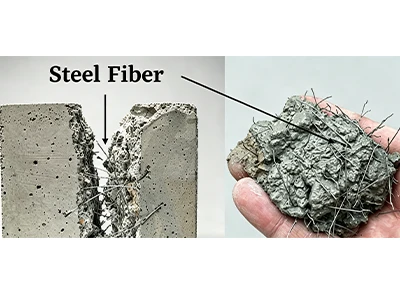
Steel fiber: One of the most common fibers used to reinforce concrete, it exhibits significant reinforcing properties due to its high tensile strength and stiffness. Steel fiber effectively bridges cracks, reducing crack propagation and increasing the tensile, flexural, and impact resistance of concrete. Its primary mechanism of action is crack bridging and increased fracture toughness, effectively improving the overall toughness of concrete. However, steel fiber has certain limitations in dispersion, especially in large concrete volumes, where uneven fiber distribution can affect concrete performance. Furthermore, steel fiber exhibits poor resistance to chemical corrosion and moisture, limiting its application in certain specialized environments.
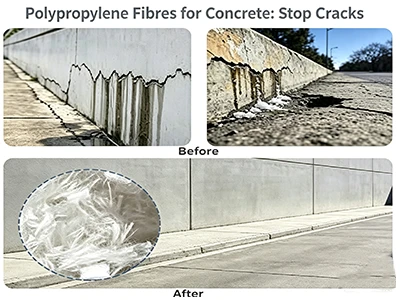
Polypropylene fiber: a synthetic fiber, exhibits excellent dispersibility and chemical resistance and is widely used in concrete. Polypropylene fiber can effectively improve concrete's crack resistance and reduce the propagation of microcracks within concrete through its fine fiber network. Polypropylene fiber has low tensile strength and stiffness, so when used alone, it may affect the overall strength of concrete. However, it can effectively control crack propagation and significantly improve concrete's frost resistance and impermeability, making it particularly effective in low-temperature environments and hydraulic engineering.
Glass fiber: Primarily used to enhance concrete's tensile strength, flexural resistance, and impact resistance. Its high strength and excellent dispersibility make it widely used in many projects. Compared to steel fiber, glass fiber offers superior chemical and moisture resistance, making it suitable for use in highly corrosive environments such as hydraulic and marine engineering. However, glass fiber is brittle and prone to breakage, limiting its application in projects requiring high ductility or fatigue resistance.
Carbon fiber: Due to its extremely high strength, low density, and excellent corrosion resistance, it has recently become an increasingly popular concrete reinforcement material. Carbon fiber can significantly increase the tensile strength of concrete. Its low density reduces concrete's weight, making it suitable for use in lightweight structures. Carbon fiber exhibits excellent resistance to high temperatures and chemical corrosion, making it suitable for projects operating in high-temperature environments and harsh chemical media. However, its relatively high cost limits its large-scale application.
Basalt fiber: A natural fiber with excellent resistance to high temperatures and chemical attack. Basalt fiber exhibits superior stability compared to steel and glass fibers in high-temperature and corrosive environments, thus holding broad application prospects in marine engineering, high-temperature conditions, and chemical engineering. The addition of basalt fiber can improve concrete's fire resistance and corrosion resistance, making it particularly suitable for use in corrosive media such as salt water and acidic environments. However, due to the high processing cost of basalt fiber, its widespread adoption in some applications remains challenging.
Nanofibers or whiskers: A newly emerging reinforcing material with exceptionally high surface area and strength. Incorporating these microfibers into concrete can improve its microstructure, further enhancing its compressive strength, crack resistance, and impermeability. For example, calcium carbonate whiskers, as a nano-scale reinforcing material, can significantly improve the compressive properties of concrete while improving the microscopic pore structure of concrete, enhancing its durability and freeze-thaw resistance.
Synergistic Mechanism Of Concrete Fibers
2.1 Mechanism of Steel Fiber Action
Steel fibers are a crucial component in enhancing concrete's crack resistance, boasting high strength, high modulus, and excellent tensile properties. Steel fibers typically bridge cracks, limiting their propagation and thus effectively improving concrete's toughness and impact resistance. When concrete is subjected to external forces, steel fibers, acting as reinforcement, resist crack propagation through their high strength, preventing rapid fracture under tension. Once cracks develop, the steel fibers bridge the cracks, acting like bridges, absorbing tensile stress and preventing further crack growth.
The introduction of steel fibers typically significantly improves concrete's tensile strength, flexural properties, and fatigue resistance. They are particularly widely used in projects subject to high load variations, such as infrastructure projects like roads, bridges, and tunnels. However, when used alone, steel fibers exhibit poor dispersion in concrete and low chemical resistance. Steel fibers are easily corroded by strong acids, bases, or high humidity, leading to performance degradation. Therefore, in practical applications, they are often combined with other fiber types to compensate for these shortcomings.
2.2 The Role of Synthetic Fibers
Polypropylene fiber, a commonly used synthetic fiber, is characterized by good dispersibility, excellent chemical resistance, and moisture resistance. Polypropylene fiber forms a microfiber network within the concrete matrix. This network significantly improves concrete's crack resistance by reducing crack width and distributing stress in the early stages of cracking.
The primary mechanism of action of polypropylene fiber is crack control. When concrete is subjected to external forces, polypropylene fiber reduces the propagation rate of microcracks by increasing the fiber network within the concrete. When cracks occur, the fibers fill the cracks and distribute stress, effectively preventing further crack expansion, thereby improving the concrete's toughness and impact resistance. Furthermore, the introduction of polypropylene fiber helps improve concrete's frost resistance and impermeability.

The Effect of Hybrid Fiber Incorporation on Concrete Performance
The application of hybrid fibers in concrete has been extensively studied, and research has shown that they can significantly improve concrete's mechanical properties, particularly its fundamental properties such as compression, tension, and flexural strength. These improvements not only enhance concrete's structural performance but also strengthen its load-bearing capacity and durability under extreme working conditions. By rationally combining different fiber types, such as steel fibers, polyvinyl alcohol fibers, and glass fibers, hybrid fibers can achieve synergistic effects, overcoming the limitations of single fibers and significantly improving concrete performance.
Compressive strength is one of the most important mechanical properties of concrete, directly impacting the safety and load-bearing capacity of concrete structures. Typically, when concrete is subjected to compressive loads, cracks initially propagate from weak points or uneven areas in the concrete. This crack propagation not only reduces the concrete's load-bearing capacity but also accelerates fatigue failure. However, the addition of hybrid fibers can effectively modify the load-bearing behavior of concrete, thereby increasing its compressive strength.

Research has shown that the introduction of hybrid fibers can significantly improve the compressive strength of concrete. Adding 0.5% and 1.0% steel fiber to high-strength self-consolidating cement (HSSCC) increased the 28-day compressive strength by 1% and 11%, respectively. The compressive strength of the experimental groups containing polypropylene fibers was lower than that of the control group. Replacing the steel fibers with 0.3% and 0.4% polypropylene fibers in hybrid fiber-reinforced samples containing 0.5% fiber significantly reduced the compressive strength of the hybrid samples.

The compressive strengths of the hybrid fiber-reinforced oil-well cement after curing for 3, 7, and 28 days were 18.4 MPa, 28.2 MPa, and 38.7 MPa, respectively. Compared with standard oil-well cement, these compressive strengths increased by 48.94%, 24.05%, and 25.68%, respectively. The hybrid fiber significantly improved the compressive strength. The addition of fibers acts as a connector within the oil-well cement matrix, inhibiting crack development and improving matrix strength. However, as the fiber content increases, the fibers become unevenly dispersed within the cement matrix and tend to agglomerate, partially offsetting the reinforcing effect of the fibers on the cement matrix. Specifically, the distribution of mixed fibers-steel, polypropylene, and bamboo-in concrete creates a three-dimensional fiber network. These fibers effectively resist the initiation and propagation of cracks when the concrete is subjected to compressive loads. Steel fibers, with their high strength and rigidity, effectively withstand and disperse compressive loads, reducing internal stress concentration in the concrete and preventing the rapid propagation of cracks.
Summary:
Concrete fiber reinforced concrete (CFRC) has been gradually applied in various fields due to its unique mechanical and durability properties. Hybrid fiber reinforced concrete (HFRC) shows broad application prospects in bridges, roads, marine structures, and high-temperature facilities. In bridge construction, HFRC can significantly improve the durability and crack resistance of structures, effectively extending their service life. In high-traffic areas such as roads and airport runways, HFRC's impact resistance and crack resistance make it an ideal material choice.
Furthermore, HFRC is particularly prominent in ultra-high-performance concrete (UHPC) and self-compacting concrete (SCC). UHPC exhibits excellent durability and strength under extreme conditions, while SCC has excellent flowability and self-compacting properties, making it suitable for complex structures. The introduction of HFRC has further optimized the mechanical properties, durability, and workability of these two types of high-performance concrete.
Although HFRC can significantly improve the mechanical properties and durability of concrete, its practical application still faces several challenges. First, the uniform distribution of HFRC in concrete remains a key issue. Due to differences in the types and lengths of hybrid fibers, the distribution of fibers in concrete may be uneven, which may lead to performance deviations in certain areas. Therefore, how to ensure the uniform dispersion of hybrid fibers in concrete has become a technical challenge in engineering applications.