




Polypropylene (PP) fibers have become a game-changer in the concrete industry! These tiny synthetic fibers offer significant benefits, enhancing concrete's strength, durability, and crack resistance. Whether you're a builder, engineer, or contractor, understanding the role of PP fibers in concrete can help improve the quality and longevity of your projects.
What is PP Fibre?
Polypropylene (PP) fiber is a synthetic fiber made from a thermoplastic polymer, specifically polypropylene resin. Made from high-purity polypropylene, PP fiber is a non-toxic and hydrophobic material. Its natural resistance to alkalis and acids makes it ideal for the harsh environments of concrete mixes. Its lightweight and chemical inertness mean it doesn't react with cement or aggregates, making it widely used in the construction industry to enhance the performance of concrete.

Types of PP Fibres Used in Concrete:
| Types | Geometric shapes | Applications |
| Monofilament fiber | Smooth cylindrical monofilaments | Inhibits plastic shrinkage cracking; used in thin-walled components, decorative concrete, and self-compacting concrete. |
| Fibrillated fiber | Calendar-stretched webs, "Y" or "X" shaped | Improves impact resistance, fatigue resistance, and residual flexural strength; suitable for industrial floors, airport runways, and tunnel linings. |
| Shaped/bundled fiber | Wavy or bundled structures | Replaces steel fiber for shotcrete and other structural applications requiring high crack resistance and durability. |
How Does PP Fibre Work in Concrete?
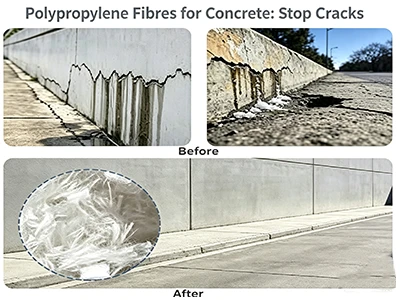
When concrete is first poured, it's still in a plastic state. Evaporation of surface moisture creates capillary negative pressure, which easily leads to a network of shrinkage cracks. At this stage, the polypropylene fibers dispersed within the concrete act like countless tiny "tension springs," providing random support in three dimensions, offsetting some of the shrinkage stress and significantly reducing the number and width of early cracks.
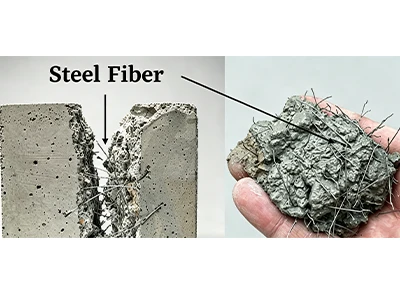
After entering the hardening stage, microcracks begin to form within the concrete. Polypropylene fibers span these cracks, "sewing" the two sides together through their surface roughness and mechanical engagement. As the cracks attempt to open further, the fibers are pulled or slightly stretched, dissipating energy. This reduces the stress concentration at the crack tip and slows the crack's propagation. If coarse fibers are used, this bridging effect can even extend to micro-cracks as small as millimeters, giving concrete a "pseudo-ductility" similar to that of metal.

Benefits of Using PP Fibre in Concrete
Enhanced Crack Resistance: PP fibers are highly effective at controlling plastic shrinkage cracking, especially in the first few hours after pouring. By forming a micro-reinforcement network, they prevent crack formation caused by drying, temperature changes, or settlement.
Enhanced Durability and Impact Resistance: Concrete infused with PP fibers is tougher and has greater energy absorption capacity. The fibers bridge microcracks and distribute stress, making concrete more resistant to abrasion, impact, and dynamic loads, especially in industrial and high-traffic applications.
Reduced Bleeding and Segregation: PP fibers help stabilize the concrete mix, reducing bleeding and aggregate segregation. This results in a denser and more cohesive mix, ensuring a better surface finish and long-term durability.
Lightweight and Corrosion-Resistant: Unlike steel mesh or metal fibers, PP fibers are 100% corrosion-resistant and significantly lighter, making them easier and safer to transport and mix.
Applications of PP Fibre in Concrete

Precast Concrete Products
PP fibre is ideal for precast elements such as manholes, pipes, panels, and retaining walls. It improves early-age crack resistance during demolding and handling, reducing product defects and waste.
Residential & Commercial Construction
From foundations and driveways to walls and roofs, PP fibre is an excellent choice in homes and commercial buildings. It ensures long-lasting results with fewer cracks and improved structural integrity.
Infrastructure Projects
Bridges, dams, canals, and marine structures benefit from PP fibre's lightweight, non-corrosive properties, especially where long-term durability and crack control are crucial.
How to Use PP Fibre in Concrete Mixes
Compatibility with Admixtures and Reinforcement Materials
Polypropylene fiber works well with most standard admixtures (plasticizers, retarders, accelerators, etc.) and can be used with traditional reinforcements such as It acts as a reinforcing steel or steel mesh. As a secondary reinforcement, it is primarily used to control premature cracking and improve matrix integrity.
Uniform Fiber Dispersion
To achieve uniform fiber distribution, ensure that the polypropylene fiber is added to the mixer slowly and steadily while the concrete is rotating. Mix for at least 3-5 minutes after addition to ensure thorough fiber dispersion. Premixing the fiber into the dry mix at dry concrete mixing plants is also effective.
PP Fibre vs. Steel Fibre vs. Glass Fibre
| Comparison Criteria | PP Fibre (Polypropylene Fibre) | Steel Fibre | Glass Fibre |
| Cost | Low cost, suitable for large-volume concrete | Higher cost, ideal for structural strength | Medium cost, requires alkali resistance treatment |
| Durability | Good, suitable for non-structural durability improvement | High strength and load-bearing capacity | Decent, but performance may degrade in alkaline environments |
| Corrosion Resistance | Stable | Prone to corrosion; needs protection in moist or chloride environments | Moderate corrosion resistance; performance decreases in strong alkali |
Conclusion
PP fibre offers an efficient, durable, and cost-effective solution for enhancing concrete performance. Its unique properties make it a valuable addition to many concrete applications, from precast elements to large-scale infrastructure. By incorporating PP fibre, builders and engineers can significantly improve crack control, durability, and overall structural integrity.