



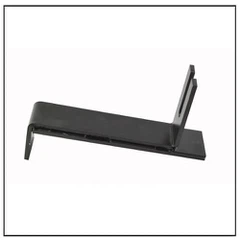


In the evolving construction industry, traditional precast concrete plant production is increasingly being replaced by automated production lines. The integration of magnetic formwork solutions is a key innovation in this transformation. These systems not only streamline production processes but also set new standards in terms of safety and precision.

Understanding Precast Plant Automation
Precast factory automation integrates robotics, CAD/BIM design tools, and ERP/MES systems to streamline the production process. From automated rebar bending and mesh welding to precise formwork placement, every step can be optimized to increase speed and accuracy.
Efficiency Improvement: Automated systems significantly reduce manual labor, minimize human error, and shorten production cycle times. For example, processes that once took hours can now be completed in minutes, enabling factories to increase production without increasing their workforce.
Precision and Consistency: Robotics and digital integration ensure that each precast component meets precise specifications. CAD/BIM models directly guide machine operations, resulting in superior dimensional accuracy and quality control compared to traditional manual methods.
Data-Driven Production: ERP/MES systems monitor workflow, inventory, and machine performance in real time. This digital monitoring helps managers optimize scheduling, track production efficiency, and quickly identify problems before they become costly.
Competitive Advantage: Precast factories that utilize automation offer increased efficiency, lower costs, and faster delivery times, giving them a distinct advantage in today's competitive construction market.
What is Magnetic Formwork?
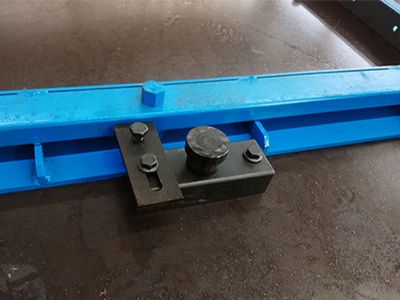
Magnetic formwork uses strong magnets to hold formwork panels securely in place. Unlike traditional clamps or bolts, magnets allow for quick adjustments and easy repositioning, even for complex layouts. This flexibility helps reduce setup time, lowers labor requirements, and speeds up production.
Features of Magnetic Formwork
Enhanced Precision and Quality: The stable magnetic force keeps panels perfectly aligned, ensuring accurate dimensions and consistent quality. Fewer misalignments reduce material waste and minimize the need for rework, saving time and cost.
Integration with Automation: Magnetic formwork works seamlessly with robotic handling and automated production lines. Robots can lift, place, and release panels efficiently, creating a smooth workflow from CAD/BIM design to casting.
Efficiency and Safety: By reducing the need for manual panel handling, magnetic formwork lowers the risk of accidents and speeds up production. Tasks that once took 30–60 minutes can now be completed in under 10 minutes, allowing plants to increase output with fewer operators.
Key Components of Magnetic Formwork Systems
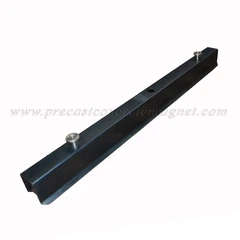
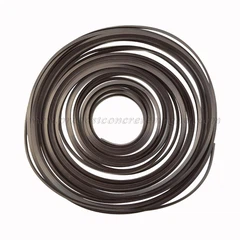
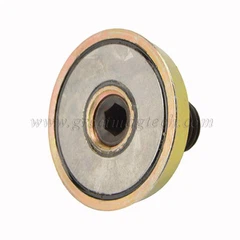
Magnetic Blocks: Provide strong adhesion and are easy to reposition.
Shuttering Magnets: Essential for holding formwork panels during casting.
Modular Systems: Allow for customization and flexibility in design.
Case Studies and Real-World Applications

We customized a set of precast concrete magnet formwork for a leading precast concrete factory in Singapore. Using our precast concrete formwork magnets in conjunction with their robotics, they enabled robotic panel handling, CAD/BIM-driven workflows, and modular magnetic modules, achieving a seamless transition from design to production. The implementation of the magnetic formwork reduced the factory's setup time by over 60%, and formwork changes that previously took nearly an hour now take less than 15 minutes. This shortened production cycle and increased output without the need for additional labor. The precision of the magnetic formwork ensures that all panels meet tight dimensional tolerances, reducing rework and minimizing material waste. This not only improves product quality but also increases the factory's profitability.
Traditional vs. Magnetic Fixture vs. Automated Production Line
| Feature | Traditional Fixture | Magnetic Fixture | Automated Production Line |
| Setup Time | 30–60 minutes | 10–20 minutes | <10 minutes |
| Labor Requirement | High | Medium | Low |
| Alignment Precision | Medium | High | Very High |
| Error & Rework | Frequent | Reduced | Minimal |
| Flexibility | Low | Medium | High |
| Integration with Digital Tools | Limited | Moderate | Full |
| Safety | Moderate | High | Very High |
| Production Speed | Slow | Faster | Fastest |
| Cost | Low initial | Medium | High initial, long-term savings |
Global Trends and Future Outlook
Adoption: Global precast plants are increasingly integrating automation and magnetic formwork. Europe and North America lead the way, while the Asia-Pacific market is rapidly catching up. Growing demand for faster, safer, and more precise production is driving widespread adoption.
Technological Advances: New magnetic systems and robotic solutions are becoming increasingly intelligent and efficient. Innovations such as smart calibration sensors, modular magnetic blocks, and AI-assisted workflow management further reduce errors and increase production output.
Market Growth: The global precast concrete automation market is expected to expand significantly over the next decade. Analysts predict a compound annual growth rate (CAGR) of over 10%, driven by urbanization, infrastructure development, and a focus on sustainable, low-waste construction methods.
Integration with Digital Tools: Current trends indicate that seamless connectivity between CAD/BIM, MES/ERP, and automated magnetic formwork will create fully digital factories. This integration not only optimizes production efficiency but also enables data-driven decision-making.
Conclusion
The integration of automation and magnetic formwork solutions is revolutionizing the precast concrete industry. These innovations not only enhance efficiency and precision but also pave the way for a more sustainable and cost-effective future in construction.
FAQ
What is magnetic formwork and how does it work?
Magnetic formwork uses powerful magnets to hold formwork panels in place, allowing quick adjustments without traditional clamps or bolts.
How does automation improve precast plant efficiency?
Automation integrates robotics, CAD/BIM, and ERP/MES systems to
Can magnetic formwork be used with robotic systems?
Yes, modern magnetic formwork systems are designed to be robot-compatible, enabling automated lifting and placement.
What are the safety benefits of using magnetic formwork?
Reduces manual handling of heavy panels, minimizes risk of accidents, and enhances operator safety.
Is magnetic formwork suitable for small or custom precast plants?
Yes, modular and flexible magnetic systems can be scaled to fit different plant sizes and production requirements.
How does magnetic formwork impact the cost of precast production?
Initial investment is higher, but long-term savings come from reduced labor, faster cycle times, and fewer errors