




Introduction
Concrete cracking is one of the most common and also the most costly quality issues in construction projects. Extensive engineering practice shows that early-age cracks are often not caused by poor material quality, but by improper selection of reinforcement or strengthening methods. Therefore, choosing the right type of concrete fiber at the early stage of a project is crucial for improving long-term performance, durability, and overall concrete quality.
In modern precast concrete and cast-in-place concrete applications, polypropylene (PP) fiber, steel fiber, and polyvinyl alcohol (PVA) fiber are the three most widely used reinforcement materials, each designed to address different structural requirements and application scenarios.
In this guide, we compare PP fiber, steel fiber, and PVA fiber from a practical engineering perspective, helping you select the most suitable fiber reinforcement solution based on load requirements, environmental exposure conditions, and budget considerations for your concrete project.
What Are Polypropylene Fibers (PP Fibers)?

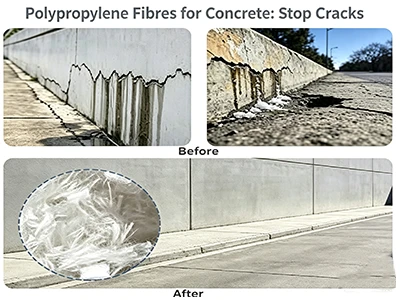
PP fibers are synthetic monofilaments or fibrils made from 100% polypropylene. PP fibers are lightweight, chemically stable, and easy to mix. Their primary design purpose is to control cracking and improve durability, rather than replacing traditional structural steel reinforcement. When used correctly, they can provide reliable performance at a very economical cost.
They have advantages such as low density, excellent alkali resistance, and non-absorbency.
The fibers are uniformly dispersed in the concrete mixture, forming a three-dimensional crack control network.
Unlike steel fibers, PP fibers do not corrode even in corrosive or humid environments.
Typical Dosage Range and Impact on Workability
The commonly used dosage range is 0.6 to 1.0 kg per cubic meter of concrete.
At appropriate dosages, PP fibers:
can reduce plastic shrinkage cracks by up to 80% to 90%.
can improve the bond strength of concrete and reduce segregation.
When uniformly dispersed, they have minimal impact on the workability of concrete.
Excessive use should be avoided, as excessive fibers may slightly affect the finish.
Common Applications
Precast concrete wall panels and floor slabs
Industrial floors and leveling layers
Tunnel linings and shotcrete
Residential and commercial concrete components
Concrete pavements and overlays
Limitations
Does not provide structural load-bearing capacity
Cannot replace rebar or steel mesh in structural elements
Limited effectiveness in post-crack structural performance
What is Steel Fiber?

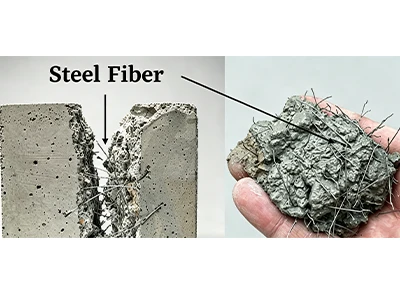
Steel fibers consist of short, dispersed steel filaments added directly to fresh concrete during the mixing process. Common shapes include hooked, coiled, straight, and deformed fibers. They are widely used in concrete structures requiring higher toughness, crack resistance, and post-cracking load-bearing capacity. Unlike steel bars or meshes, steel fibers are evenly distributed within the concrete matrix, acting in three dimensions from the inside out to enhance concrete performance.
Steel fiber bridges crack after initial cracking, allowing concrete to continue bearing loads and preventing sudden failure.
This makes it ideal for floors and pavements subjected to repeated loads or dynamic forces.
Compared to ordinary concrete, cracks are finer and more evenly distributed.
Typical Dosage Range
The typical dosage range is 20 to 60 kg/m³, depending on design requirements and fiber type.
Higher dosages can improve toughness and load-bearing capacity, but improper mixing may slightly reduce workability.
With proper mix design and batch control, steel fiber reinforced concrete can maintain good pumpability and surface quality.
Construction efficiency can be improved by reducing the time required for reinforcement placement and tying.
Common Applications
Industrial and warehouse floors
Roads and floors
Precast concrete components
Tunnel and shotcrete linings
Limitations
1. In corrosive or marine environments, exposed fibers may corrode if not properly protected.
2. If surface treatment is poorly controlled, fibers may become visible on the surface.
3. The material cost is higher than that of synthetic fibers; therefore, its rationale must be justified by improvements in structural performance.
What Is PVA Fiber (Polyvinyl Alcohol Fiber)?

PVA fibers are highly hydrophilic synthetic polymer fibers designed to enhance the durability, crack control, and long-term structural reliability of concrete. PVA fibers are renowned for their excellent bond properties with cementitious materials and are widely used in advanced concrete systems where crack width control and ductility are critical.
They possess high tensile strength and excellent elongation.
They are stable in alkaline concrete environments.
After thorough mixing, the fibers are uniformly dispersed.
Typical Dosage Range and Impact on Workability
Typical Dosage: 1.0–2.0 kg/m³ (depending on the project)
Significantly reduces early and drying shrinkage cracks
Improves load-bearing capacity after cracking without increasing section thickness
Excessive use may slightly reduce concrete workability
Common Applications:
High-performance precast concrete slabs
Thin building components
Engineering cement-based composites (ECC)
Crack-prone components and capping layers
Limitations:
Higher material cost
Not suitable for replacing steel reinforcement in high-load structural members
Requires careful mixing to avoid fiber clumping
PP Fiber vs Steel Fiber vs PVA Fiber
| Performance Factor | PP Fiber | Steel Fiber | PVA Fiber |
| Primary function | Plastic shrinkage crack control | Structural reinforcement | Micro-crack control & ductility |
| Crack control stage | Early-age stage | Post-cracking stage | Whole service life |
| Tensile strength contribution | Low | High | Medium |
| Load-bearing capacity | Minimal | Excellent | Limited |
| Bond with cement matrix | Mechanical bonding | Mechanical anchorage | Chemical bonding |
| Impact & fatigue resistance | Moderate improvement | Significant improvement | Good improvement |
| Effect on workability | Minimal | Moderate | Moderate |
| Surface finish risk | No rust, smooth surface | Possible fiber exposure | Very smooth finish |
| Typical cost level | Low | Medium–High | High |
Cost and Economic Efficiency Comparison
A clear comparison of the cost and economic efficiency of polypropylene (PP) fiber, steel fiber, and polyvinyl alcohol (PVA) fiber can help you make informed investment decisions.
Polypropylene Fiber (PP Fiber)
PP fiber has the lowest material cost and the least impact on mixing and placing concrete. It disperses easily, requires no special handling, and adds virtually no additional labor. For projects focused on plastic shrinkage crack control and durability improvement, PP fiber delivers excellent value at the lowest cost per cubic meter.
Steel Fiber
Steel fiber comes with a higher upfront material cost, but it can reduce or partially replace traditional rebar or steel mesh. This often results in labor savings and faster construction progress on large-scale or heavy-duty projects.
Polyvinyl Alcohol (PVA) Fiber
Although PVA fiber has the highest material cost, its outstanding crack control performance and ductility can significantly reduce repair, maintenance, and overall life-cycle costs in high-performance applications. For thin or crack-sensitive elements, its long-term performance often justifies the higher initial investment.
How to Choose the Right Concrete Fiber for Your Project

When selecting PP, steel, and PVA fibers, a comprehensive evaluation based on material properties, service environment, and life-cycle cost should be conducted, rather than a decision based on a single indicator.
PP fibers, with their excellent chemical inertness and lightweight properties, can effectively suppress early plastic shrinkage cracks in concrete and add almost no structural weight. They offer significant cost-effectiveness advantages in applications requiring chemical corrosion resistance, non-structural crack control, and lightweighting. However, their relatively low modulus of elasticity limits their ability to improve the strength of hardened concrete.
Steel fibers, with their high strength and high modulus, can significantly improve the tensile, flexural, impact, and fatigue resistance of concrete, making them suitable for heavy-duty structures and high-stress components, and even partially replacing traditional steel reinforcement. However, their corrosion risk in chloride environments and electrical conductivity necessitate cautious use in corrosive or electromagnetically sensitive environments.
PVA fibers represent the direction of high-performance cementitious composites. Their strong adhesion to the cement matrix and high alkali resistance enable excellent crack dispersion and ductility. Despite the high initial cost, it possesses outstanding life-cycle value in structures with extremely high requirements for seismic toughness and durability.
Conclusion
In summary, PP fiber, steel fiber, and PVA fiber represent three different strategies and dimensions for concrete reinforcement and modification. PP fiber is an economical and efficient "crack-resistant guardian," suitable for large-scale civil engineering projects and corrosive environments. Steel fiber provides the "skeleton of strength and toughness," making it the first choice for demanding mechanical scenarios such as heavy loads and blast resistance, but the risk of corrosion must be considered. PVA fiber, on the other hand, is the "engine of high-performance toughness," endowing concrete with extremely high ductility and crack control capabilities. The right choice depends on your project's performance requirements, exposure conditions, and budget. A wise choice will result in better concrete performance, a longer service life, and less maintenance requirements throughout its lifespan.
FAQ
Q: What are the core differences between PP fiber, steel fiber, and PVA fiber?
A: The essential difference lies in their mechanical properties and stage of action. PP fiber primarily controls early-stage plastic shrinkage cracking in concrete; steel fiber provides structural load-bearing capacity and improved toughness; PVA fiber achieves micro-crack dispersion and high ductility through strong interfacial bonding.
Q: Which fiber is more suitable for preventing early cracking?
A: PP fiber is the most suitable choice. It effectively inhibits plastic shrinkage cracking, is low-cost, has good dispersion, and does not significantly affect the concrete mix proportions or self-weight.
Q: Can steel fiber completely replace steel reinforcement?
A: No, it cannot completely replace it. Steel fiber can reduce or simplify steel reinforcement in some designs, but in structural members with clearly defined load paths and concentrated stress, it still needs to be used in conjunction with traditional steel reinforcement.
Q: Which fiber should be preferred in corrosive or humid environments?
A: PP fiber or PVA fiber should be preferred. They do not rust, are resistant to chemical corrosion, and are more suitable for underground engineering, coastal buildings, or chemical environments.
Q: Why is PVA fiber often used in high-performance concrete?
A: PVA fibers exhibit extremely strong interfacial adhesion to the cement matrix, significantly improving the tensile strain capacity and crack dispersion of concrete, making them a key reinforcing material in high-ductility cementitious composites (ECC).
Q: Which fiber has the lowest overall cost?
A: From the perspective of initial material cost, PP fibers are the lowest; steel fibers are in the middle; and PVA fibers are the highest. However, considering the total life-cycle cost, PVA fibers are more economical in projects with high durability and safety requirements.
Q: Can different fibers be mixed in the same mix proportion?
A: Yes. In some projects, combinations of PP fibers + steel fibers or PP fibers + PVA fibers are used to simultaneously control early cracking and improve later performance, but mix proportions and construction verification are required.