





The safety technical points of prefabricated building construction mainly include six aspects: basic requirements, component transportation, component storage, component hoisting, temporary fixation of PC components, and stair edge protection.
Basic requirements
1. A special plan should be developed for the construction of prefabricated concrete structures. The special construction plan should include project overview, preparation basis, progress plan, construction site layout, prefabricated component transportation and storage, installation and connection construction, green construction, safety management, quality management, information management, emergency plan, etc.
2. Prefabricated components, installation materials and accessories should comply with the relevant national standards and product application technical manuals, and should be inspected on site in accordance with the relevant national standards.
3. Site preparation: Arrange the component storage yard and vehicle transportation lanes reasonably according to the site conditions, review the loads of the storage yard and transportation lanes, and reinforce the floors in areas that do not meet the load requirements.

Prefabricated Building Construction Site
4. Technical preparation: Study relevant national and local technical specifications and regulations, be familiar with PC detailed design drawings, and use BIM technology to prepare prefabricated structure construction organization design, hoisting plan, edge protection plan and safety technical briefing, etc.
5. Mechanical preparation: Before installation and construction, the lifting capacity of the lifting equipment should be reviewed. In accordance with the relevant provisions of the current industry standard "Technical Regulations for Safety in the Use of Construction Machinery" (JGJ33), check and recheck that the hoisting equipment and spreaders are in safe operating condition, and verify whether the on-site environment, weather, road conditions, etc. meet the requirements for hoisting construction; protection system Erection and acceptance should be carried out in accordance with the construction plan.
6. Labor force allocation: Select an experienced hoisting unit and provide corresponding training and guidance for hoisting labor personnel.
7. Construction of model area: For qualified projects, it is recommended to arrange a construction model display area and familiarize yourself with the hoisting process and node construction technology in advance.
Component Transportation
1. Before the components are officially transported, the route should be surveyed in advance. Carefully understand the road conditions, condition restrictions, etc. of the pre-selected route, so as to make final adjustments to the transportation route and determine the most reasonable route.
PC component loading and transportation
2. During temporary construction at the construction site, the length and weight of the component transport vehicle should be fully considered, the temporary road on site should be widened, engineering muck should be laid and compacted under the road, and steel bars should be installed in the temporary road. Through relevant measures, ensure that components can be transported to the construction site smoothly.
3. Transport vehicles must be maintained and inspected annually, and must not be overloaded. The loading and fixing methods of components must be reasonably designed, and anti-overturning measures must be strictly checked to ensure fastening and avoid overturning.
Storage of Components
The construction site should set up transportation channels and storage areas according to the construction plan, and should comply with the following regulations:
1. The on-site road transportation and storage site should be solid and flat, and should have drainage measures.
2. The roads within the construction site should have a reasonable turning radius and road slope according to the requirements of component transport vehicles.
3. After the prefabricated components are transported to the construction site, separate storage areas should be set up according to specifications, varieties, usage parts, and lifting sequence. The storage area should be set up within the effective lifting range of the hoisting equipment, and passages should be set up between the piles.
4. The storage rack of components should have sufficient resistance to overturning.
5. The impact of component transportation and storage on the completed structure and foundation pit should be calculated and reviewed.
Component Hoisting
1. The construction unit should conduct safety training and briefings for prefabricated component hoisting operations and related personnel, identify operational risks in each link of prefabricated component entry, unloading, storage, hoisting, and placement, and formulate prevention and control measures.
2. Before the installation operation begins, the installation operation area should be maintained and clearly marked, cordons should be drawn, side stations should be arranged according to the level of hazard sources, and personnel unrelated to the installation operation should be strictly prohibited from entering.
3. Special spreaders, slings, shaped tool supports, brackets, etc. used in construction operations should be safety checked, and regular or irregular inspections should be carried out during use to ensure their safety status.
PC Component Hoisting
4. The safety of hoisting operations should comply with the following regulations:
(1) After lifting the prefabricated components, the prefabricated components should be lifted about 300mm first, then the components should be stopped, the status of the wire ropes, spreaders and prefabricated components should be checked, and the components can only be slowly lifted after confirming that the spreaders are safe and the components are stable;
(2) Non-operation personnel are strictly prohibited from entering the crane lifting area;
When transporting prefabricated components, it is strictly forbidden for people to stand under the components. Operators should wait until the prefabricated components have landed within 1 m from the ground before they can approach, and they can be unhooked after being fixed in place;
(3) The direction of prefabricated components should be changed through wind ropes at high altitudes, and it is strictly prohibited to directly hold prefabricated components with hands at high altitudes;
(4) Hoisting operations are not allowed when encountering rain, snow, or fog, or when the wind force is greater than level 5.
5. Temporary fixation of PC components
1. When using a lifting device to lift wall panels, do not loosen the hook before positioning and fixing the lifting components.
2. The site should be equipped with sufficient fixed accessories and installation and operating tools, and the components should be fixed in time after they are in place.

6. Protection of Stair Edges
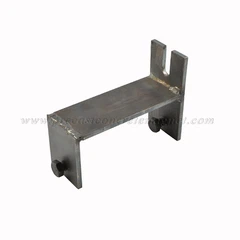
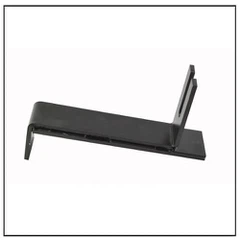
1. After the stair treads are installed, special clamps should be used to install edge protection.
Stair edge protection
2. How to use stair fixtures:
(1) Use iron parts to clamp the side of the stair platform plate and tighten the fastening bolts.
(2) After the two-run staircase is installed, a 15-20mm gap should be reserved in the middle. Use the gap between the rest platforms to insert the screw into the gap. Set a gasket under the platform and tighten the nut.