








Introduction
In the production of precast concrete, allocating the appropriate number of shuttering magnets to each precast panel is crucial for achieving precise, stable, and efficient production results. An insufficient number of magnets may lead to the displacement or misalignment of the precast panels, whereas an excessive number results in unnecessary cost wastage. In this guide, we will delve into the various factors influencing the number of magnets required for each precast panel, offering practical advice and expert recommendations.
What Are Shuttering Magnets and Their Role in Precast Concrete Production?
Definition of Shuttering Magnets
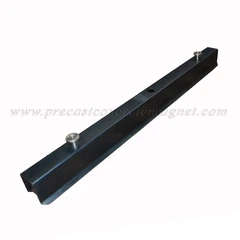
Shuttering magnets are high-strength magnetic fixing devices designed to secure formwork systems onto steel casting beds during precast concrete production. They are equipped with a powerful magnetic core, typically made of neodymium and enclosed in a durable steel housing. Once the switch is activated, they generate a strong holding force that firmly attaches the formwork to the steel surface.
Why Are They Essential in Precast Concrete Production?
In precast production, precision and stability are fundamental requirements. Even slight movement during concrete pouring or vibration can lead to dimensional inaccuracies and costly rework. Shuttering magnets ensure that side forms and molds remain securely fixed in place, maintaining precise alignment throughout the casting process. Their consistent holding force helps ensure uniform product quality and reduces variations between production cycles.
How Do They Simplify the Production Process?
Compared to traditional methods such as bolting or welding, shuttering magnets significantly simplify formwork installation and adjustment. Operators can position, activate, and reposition magnets within seconds, making them ideal for factories producing panels of various sizes. This flexibility reduces labor intensity, shortens production time, and minimizes damage to steel casting beds.
Common Applications
Shuttering magnets are widely used in the production of various precast concrete elements, including wall panels, floor slabs, beams, and columns. Their advantages are especially evident in modular construction and large-scale production environments, where consistency and efficiency are critical.

Shuttering Magnet

Shuttering Magnetic For Vertical Mould

Shuttering Magnet Of Side Rods

Precast Concrete Shuttering Magnet
Factors That Determine the Number of Shuttering Magnets Per Panel
Panel Size and Thickness
Panel size is the primary factor to consider. Larger panels have longer formwork edges, which require more fixing points to maintain proper alignment. As the weight of the concrete element increases, the lateral pressure generated during pouring also becomes greater. Thin slabs may only need moderate support, while thick wall panels behave very differently under vibration and load. Placing additional magnets along edges and corners helps distribute forces evenly and prevents localized movement. In practice, larger and thicker panels generally require a denser magnet layout to ensure stability throughout the entire production process.
Load-Bearing Capacity of the Magnets
Not all magnets perform the same. Magnets with a holding force of around 450 kg are suitable for light-duty applications, while 900 kg, 1800 kg, or higher-force magnets are designed for structural elements. A higher holding force may reduce the total number of magnets required-but only to a certain extent. Relying on too few high-strength magnets can lead to uneven load distribution. A balanced approach-combining sufficient holding force with proper spacing-ensures consistent performance and overall stability of the formwork.
Panel Type and Application
Different precast elements require different fixing strategies. Wall panels typically demand strong edge control, slabs require evenly distributed magnets, and beams or columns may need concentrated fixing at key load-bearing points. The geometry of the element and its structural function directly influence both magnet placement and quantity.
Environmental Conditions
External factors should not be overlooked. Temperature, humidity, and surface cleanliness can all affect magnet performance. Dust, rust, or uneven steel surfaces can reduce effective holding force. In such cases, additional magnets may be needed to maintain formwork stability.

How to Calculate the Right Number of Shuttering Magnets for Each Panel
General Rule of Thumb
As a starting point, many precast factories follow a simple guideline: approximately one shuttering magnet is required for every 0.5 to 1 square meter of panel surface area. This range varies depending on panel thickness, concrete casting pressure, and the holding force of the magnets. In general, thicker panels or those subjected to higher casting loads require closer magnet spacing, while lighter and thinner panels allow for wider spacing between magnets.
Step-by-Step Calculation Process
A more reliable approach is to combine area-based estimation with actual load considerations. First, measure the total surface area of the precast panel to determine its overall size and the length of the formwork. Next, evaluate the rated holding force of the selected magnets and compare it with the expected lateral pressure generated by fresh concrete during pouring. Then, distribute the magnets evenly along the formwork edges to ensure balanced load transfer across the system.
Example Calculation
For a wall panel measuring 3 × 2 meters with an approximate weight of 2000 kg, a typical configuration would require 6 to 8 shuttering magnets. If higher-strength magnets are used, fewer units may be sufficient. Conversely, if smaller or lower-force magnets are selected, a greater quantity will be needed to achieve the same level of stability. The key objective is to maintain consistent and reliable holding force throughout the entire formwork system.
Adjustments for Special Conditions
In real production environments, conditions rarely match standard assumptions. Larger panels, thicker sections, or high-vibration casting conditions often require additional magnets. Edge zones and corner areas may also need reinforcement. Increasing the number of magnets in critical load-bearing areas enhances safety, reduces the risk of formwork movement, and ensures consistent panel quality throughout the production cycle.

Benefits of Proper Shuttering Magnet Distribution
Improved Accuracy and Stability
Properly distributed shuttering magnets create a balanced holding force across the entire formwork system. When magnets are arranged at appropriate intervals, side rails and molds remain firmly secured during concrete pouring and vibration. This stability ensures precise dimensions and straight edges, reducing defects such as misalignment, slurry leakage, or uneven surfaces. In precast production, accuracy is not optional-it directly determines the final product quality.
Reduced Labor Costs
An efficient magnet layout significantly reduces the need for repeated manual adjustments. When magnets are positioned correctly from the start, operators spend less time correcting alignment or reinforcing weak areas. This streamlined process improves overall efficiency and reduces reliance on labor-intensive rework.
Faster Setup Time
Shuttering magnets are designed for speed. Once positioned, they can be activated instantly without tools or complex procedures. With a well-planned magnet arrangement, formwork assembly and adjustment can be completed in minutes rather than hours. In large-scale production environments, this time-saving advantage becomes increasingly valuable, as efficiency gains accumulate with each casting cycle.
Long-Term Durability
Proper magnet distribution not only enhances immediate performance but also extends the service life of both the magnets and the entire formwork system. Even load distribution reduces stress on individual magnets, preventing localized wear. At the same time, eliminating welding and drilling preserves the structural integrity of steel casting beds, reducing maintenance issues and ensuring reliable long-term operation.
Conclusion:
The number of shuttering magnets required for each precast panel is critical to the success of precast concrete production. By comprehensively considering factors such as the dimensions and weight of the precast panels, as well as environmental conditions, you can calculate the optimal quantity of magnets needed-thereby ensuring a production process that is stable, precise, and efficient. Whether you are undertaking a small-scale residential precast project or a large-scale commercial undertaking, mastering the efficient utilization of shuttering magnets will help you save time, reduce costs, and comprehensively enhance overall production performance.
FAQ
Q: How many shuttering magnets are needed per panel?
A: The required number depends on the panel's size, thickness, and the holding force of the magnets. As a general guideline, one magnet is typically used for every 0.5 to 1 square meter of panel area. Heavier or thicker panels usually require more magnets to ensure stability during concrete pouring.
Q: What happens if too few magnets are used?
A: Using too few magnets can cause the formwork to shift during concrete pouring or vibration. This may lead to dimensional inaccuracies, surface defects, or even structural misalignment, resulting in costly rework.
Q: Can stronger magnets reduce the total number required?
A: Yes, using higher-strength magnets can reduce the total quantity needed. However, proper spacing and even distribution remain essential. Relying on only a few strong magnets without balanced placement can still result in uneven load distribution.
Q: How should shuttering magnets be spaced?
A: Magnets should be evenly distributed along the edges of the formwork, with closer spacing at corners and high-stress areas. Consistent spacing helps maintain uniform holding force and prevents weak points.
Q: Do different types of panels require different magnet layouts?
A: Yes. Wall panels, slabs, beams, and columns have different load conditions and formwork designs. Each type may require adjustments in both the number of magnets and their placement strategy.
Q: How can magnet usage be optimized in production?
A: Start by establishing a standard layout based on panel size, then refine it based on actual performance. Monitoring formwork stability during pouring and continuously improving placement strategies will help achieve the most efficient configuration.
Q: Are shuttering magnets reusable?
A: Yes. High-quality shuttering magnets are designed for repeated use. With proper handling, cleaning, and storage, their holding force can be maintained, and their service life significantly extended.
Q: What is the most common mistake when using shuttering magnets?
A: The most common mistake is focusing only on the number of magnets while ignoring their placement and load distribution. Proper positioning is just as important as the quantity used.