





Introduction
Precast formwork magnets have revolutionized the way precast concrete elements are manufactured and assembled. These powerful magnetic solutions eliminate the need for traditional fixing methods like drilling, welding, or bolting. They offer a faster and more efficient alternative. In modern precast production, we know that precision and efficiency are crucial.
Precast concrete manufacturers use formwork magnets to secure molds. They are also used to create highly accurate shapes without compromising quality.
Unlike mechanical fasteners, which can damage formwork surfaces, magnets offer a reusable and environmentally friendly solution. We usually use shuttering magnets for securing formwork.
This article explores the various types of precast formwork magnets, their applications, and their benefits along with guidance on how to select the right magnet for specific needs. We will also cover a step-by-step guide for their usage, and how these high-quality products can enhance efficiency.
What Are Precast Formwork Magnets?
Precast formwork magnets have completely transformed the way precast concrete elements are manufactured and assembled. By using a magnetic fixing system for precast concrete, manufacturers can eliminate traditional methods like drilling, welding, or bolting, achieving a faster and more efficient workflow. Modern precast production increasingly relies on high-quality precast concrete formwork accessories to ensure precision, durability, and consistent results.
Among these accessories, shuttering magnets play a crucial role. Their versatile shuttering magnet applications allow molds, panels, and inserts to be held securely without damaging surfaces, while reusable magnetic formwork systems provide cost-effective and eco-friendly solutions for repeated use. Additionally, magnetic boxes for precast concrete offer an innovative way to organize and position molds accurately, enhancing overall workflow efficiency.
By integrating these magnetic solutions, manufacturers can significantly improve precast concrete production efficiency, reduce material waste, and achieve consistent, high-quality finishes. This article will guide you through the different types of precast formwork magnets, their applications, and tips for selecting the ideal magnet to maximize productivity and streamline operations with reusable magnetic formwork systems.
Types of Pre-cast Formwork Magnets and Their Applications
Modern concrete manufacturing is not complete without employing precast formwork magnets, powerful, reusable, and efficient tools when compared to traditional fastening methods, like welding, bolting, or adhesives. These magnetic formwork systems are used on onsite formwork panels, molds, and inserts during concrete pouring and curing to ensure everything is perfectly aligned, stable, and produces a high-quality finish.
The benefits of using precast formwork magnets include strong magnetic holding force, which allows panels to be firmly secured without damaging surfaces. These magnets also eliminate setup and removal times, making the production process more cost-effective and efficient. As part of a complete set of precast concrete accessories, they form an essential concrete formwork fixing solution for modern precast operations.
With an understanding of the various kinds of precast formwork magnets and their applications, manufacturers can select the most appropriate magnetic solutions for their needs. Shuttering magnets and reusable formwork magnets are two of the most commonly used types.
Shuttering Magnets
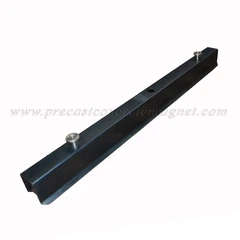
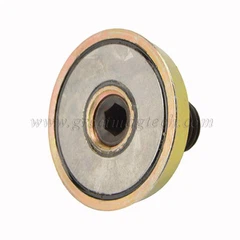
One of the most popular precast formwork magnets is the shuttering magnet, used to fix wooden, steel, or plastic formwork panels during concrete pouring and curing. These magnets feature a high-strength magnetic core fully encased in steel for protection and durability. The push-button activation allows quick engagement and release without additional tools, making fast formwork adjustments simple and efficient.

Advantages of shuttering magnets:
- High holding power
- Reusable
- Durable
- Easy to use and operate
- Guarantee no surface damage
Formwork Magnets
Another type, the reusable formwork magnet, holds molds, inserts, and reinforcement components securely during the concrete casting process. Unlike traditional fixing methods like drilling or adhesives, these magnets provide a cleaner, more efficient concrete formwork fixing solution.
For high-precision applications, formwork magnets are widely used for architectural concrete panels, structural elements (columns and beams), and modular components (stairs and stair stringers). They ensure consistent alignment, protect surfaces, and enhance productivity.
Advantages of formwork magnets:
- Consistent alignment
- Ensures precise mold position
- Easy to handle
- Quick setup and removal
- Enhance durability
- Compatible with different materials.

Comparison of Precast Formwork Magnets
|
Magnet Type |
Application |
Key Features |
Material Compatibility |
|
Shuttering Magnets |
Securing formwork panels (wood, steel, plastic) |
High holding power, push-button activation, reusable |
Wood, steel, plastic |
|
Formwork Magnets |
Holding molds, inserts, and reinforcements |
Precise positioning, no surface damage, compact size |
Steel, concrete, plastic |
Advantages of Using Shuttering Magnets and Formwork Magnets

The usage of shuttering magnets and formwork magnets in precast concrete manufacturing have significantly greater advantages than traditional fastening methods like nails, screws, welding, as well as adhesives.
As such, these high-strength, reusable magnetic solutions improve production efficiency, surface quality, and cost effectiveness while easing and making the operations safer and often more environmentally friendly.
Integration of shuttering magnets and formwork magnets into the manufacturers' workflows will give them higher precision, faster assembly times, and lower material waste. The main advantages of using these precast formwork magnets are listed in the order as follows.
Increased Efficiency
Fast setup is made possible by shuttering and formwork magnets. Unlike traditional mechanical fixings such as drilling, bolting, or welding, these magnets offer instant attachment and release to streamline the entire precast concrete molding process.
The ease with which these magnets can be used to turn and unturn makes them a perfect solution for high-volume precast production.
Quick mold adjustments
Faster mold release
Enhanced Precision and Surface Quality
In the case of precast concrete elements, the traditional mechanical fixings tend to leave surface defects on the same, such as holes, cracks, and uneven edges. On the other hand, the shuttering and formwork magnets provide very efficient, even pressure distribution.
This ensures, along with formwork stability, as well. In addition, it helps the workers to put the casting process in perfect alignment.
No screw holes or surface damage
Consistent mold alignment
Defect-free finished product
Provides smoother and higher-quality precast products
Cost Savings and Reusability
Although shuttering and formwork magnets may cost more initially than traditional fastening methods, they save in the long run as they can be reused and withstand longer. Magnetic cables of this type are unlike screws or nails, which are known to degrade and need to be reconnected.
These cost-effective benefits make shuttering and formwork magnets a good investment for manufacturers that want to improve operational efficiency and bring down operational costs.
Long-lasting performance
Lower cost of materials
Lower maintenance expenses
How to Use Precast Formwork Magnets
Proper use of precast formwork magnets is crucial to ensuring precision, safety, and efficiency in concrete production. These magnetic formwork systems simplify the process of securing molds and panels, reducing setup time while preventing surface damage.
Step 1: Select the Appropriate Magnets
Select appropriate formwork magnets or reusable formwork magnets based on the type of precast concrete accessories used and the weight and material of the formwork.
Step 2: Clean the Formwork Surface
Ensure the formwork panel surface is clean and free of dust and debris. This improves magnetic adhesion and prevents misalignment during pouring.
Step 3: Position and Secure the Magnets
Place the precast formwork magnets in the desired location. Press a button or lever to lock them into place. Check alignment to ensure the magnets provide a secure hold without damaging the panel.
Step 4: Place and Cure Concrete
After the concrete formwork fixative is applied, begin pouring the concrete. The magnets maintain alignment and pressure throughout the curing process, ensuring a high-quality, defect-free surface.
Step 5: Release and Reuse
After the concrete has set, release the reusable formwork magnets and carefully remove them. Store it in a dry, controlled environment until it is ready for the next production cycle.
Innovations in Shuttering Magnets and Formwork Magnets Technology
Shuttering magnets and formwork magnets have advanced much in technology, improving precast concrete production and yielding higher efficiency, precision, and durability. In a process that involves these types of innovations, manufacturers can gain faster setup times, better quality control, and economical operations.
Modern precast concrete production has become less reliant on these magnets to the point of becoming indispensable with continuous improvements in magnetic strength, automation, and smart monitoring.
The latest innovations in shuttering and formwork magnets concentrate on enhanced holding power, adjustable holding power, automation of placement, and intelligent monitoring. These advancements allow the manufacturers to optimize their production process.
High-Performance Shuttering Magnet Design
Great improvements have been made in shuttering magnets by using stronger cores and reinforced steel casings for superior holding forces and durability. All of these innovations make shuttering magnets more reliable, even in harsh construction environments.
Gaining new designs simplifies wear and protects the magnet with decorative coated surfaces that are more resistant to corrosion and wear, resulting in an extended lifespan. Also, compact yet high-performance magnetic configurations provide better strength for the size.
Adjustable Magnetic Systems
Adjustable shuttering magnets have recently been introduced, which has made the precast concrete production flexible. What these systems do is give operators to adjust the level of holding force based on the requirements of a specific project.
Adjustable magnetic systems make use of mechanical levers or electronic control to change the magnetic strength to use the materials efficiently and align the system with precision. This feature is perfectly useful when dealing simultaneously with varying panel sizes and weights, as it prevents too much force, which will likely damage the components of delicate formwork.
Automated Magnet Positioning Systems
Automation is taking the precast concrete industry by storm, and automated magnet positioning systems are at the forefront of all of the change. The formwork magnets are precisely placed and secured on the timber of a building formation by robotic placement mechanisms or computer-controlled magnetic arrays without manual intervention.
It increases speed and accuracy over manual magnet positioning and decreases the risk for misalignment and inconsistency of precast elements.
Integration of Smart Monitoring Systems
Manufacturers today can now track in real time data, including shuttering and formwork magnet positioning, holding force, and environmental conditions, using smart shuttering and formwork magnets.
These smart monitoring systems do provide details that improve quality control, predictive maintenance, and overall efficiency.
Comparison of Innovations in Shuttering and Formwork Magnets
|
Innovation |
Key Benefit |
|
High-performance shuttering magnets |
Stronger holding power, enhanced durability |
|
Adjustable magnetic systems |
Flexible holding force, improved precision |
|
Automated magnet positioning |
Faster setup, reduced manual labor |
|
Smart monitoring systems |
Real-time tracking, optimized quality control |
Proper Magnet Maintenance
The prolonging of precast formwork magnets' lifespan, their holding strength,h, and smoothness of production works is what they requires regular maintenance. Less maintenance can result in decreased magnet effectiveness, as well as more setup time and possible safety hazards.
A structured cleaning and storage routine will help to prevent costly replacements and downtime.
Clean and Remove Residue
As they accumulate time, dust, concrete residue, and rust build up on the magnets' surface, reducing the holding force.
Corrosion Prevention
Mags should be sprayed down with anti-corrosive spray and kept in a dry, temperature-controlled environment to prevent rust and corrosion. If exposed to moisture, magnets should be dried with a dry cloth as soon as possible.
Inspecting for Wear and Damage
Workers should check for:
- Cracks or chipping in the casing of the magnet.
- Magnetic force weakened, which may mean internal damage.
Proper Storage for Extended Lifespan
Hence, magnets should be stored far away from high temperatures and strong electrical fields that may disturb their magnetic property. Therefore, magnets should always be stored in designated holders or racks, and should not be stacked incorrectly to prevent their loss of efficiency over time.
Conclusion
In modern concrete production, precast formwork magnets are absolutely necessary. They are efficient to use. Choosing proper magnet selection and having regular maintenance improves productivity and safety. The preventive measures can work against challenges such as misalignment and residue build-up.
Although technological advancements such as adjustable holding force and authenticated positioning add further to efficiency, they reduce labor costs and quality.
To hit the smart option, invest in high-quality formwork magnets and practice best practices. The use of the right magnetic solutions for precast concrete construction can enable increased accuracy and reduced costs.