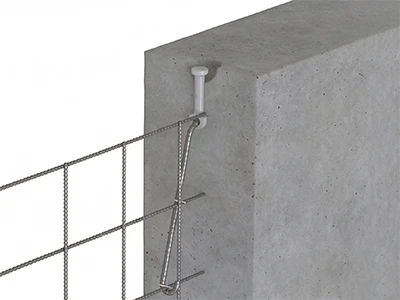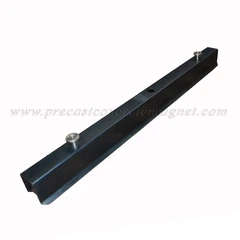
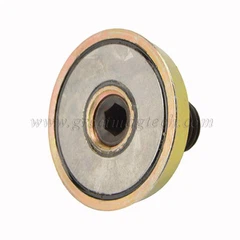


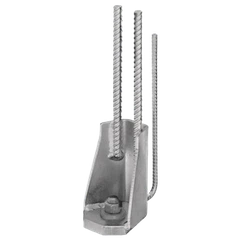
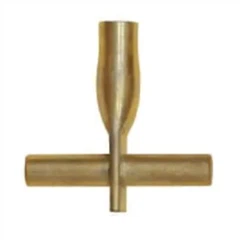

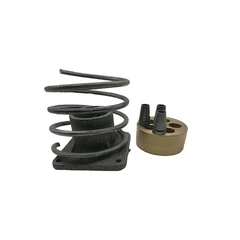

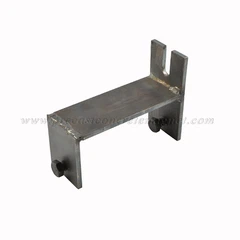
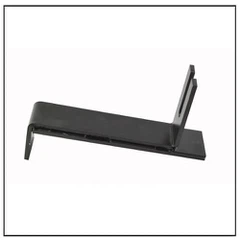


The erection anchor system is a technology used for lifting precast concrete components, mainly made of steel plates. This erection anchor system includes an erection anchor (tech erection) and a special spreader with a rotating pin. During the installation process, it is necessary to use an oblate spherical former to fix the hanging nails to ensure that they form a stable groove on the concrete surface to provide sufficient load-bearing capacity and safety.
The design of the flat-panel hanging nail allows hooks to be opened at the end, so that the latch can be turned to prevent the hook from falling off, increasing the reliability of the hoisting. In addition, compared with other commonly used lifting systems such as lifting anchor systems and wavy tail anchor systems, the erection anchor system has its specific application scenarios and advantages and is suitable for different component types and lifting environments.
The erection anchor system is an efficient and safe pre-embedded lifting anchor solution, especially suitable for lifting operations of precast concrete elements. Through precise design, manufacturing, and reasonable installation methods, construction efficiency can be effectively improved and safety ensured.
What Are The Installation Steps And Precautions For An Erection Anchor System?

Installation Steps:
Choosing The Right Precast Concrete Element Lifting System
First, you need to ensure that the erection anchor system selected is suitable for precast concrete elements. According to the company, no special grooves need to be formed in the concrete surface when installing and fixing, which means that universal spreaders can be used for quick and easy installation.
Use Wire Rope Slings And Universal Spreaders
The supporting hoists include wire rope, soft rope lifting clutch, and universal lifting clutch. However, it should be noted that the soft rope lifting clutch cannot be used for flipping and hoisting components. This shows that when lifting and transporting, the universal lifting clutch can be quickly removed by rotating the spreader tongue to release the load.
Ensures Compatibility With Other Mounting Systems
The installation process should be quick and easy, and the bracket and lifting systems should be compatible. This means that when lifting and transporting, you need to ensure that the lifting equipment selected is compatible with the existing support system to facilitate operation.
Precautions:
When carrying out hoisting and transportation, special attention should be paid to the fact that the soft rope spreader cannot be used for flipping and hoisting the components. In addition, it is also necessary to ensure that all precast wall panels are lifted using the erection anchor system to avoid possible problems.
In summary, the installation steps for a flatbed nailing system involve selecting an appropriate lifting system, using a wire rope lifting clutch and a universal lifting clutch, as well as ensuring compatibility with other support systems.
Compare With other lifting Systems
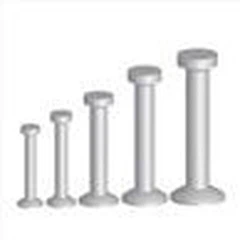
| Lifting Systems | Erection Anchors Systems | Lifting Anchor Systems | Wavy Tail Anchor Systems |
| Picture |  |
 |
 |
| Advantage | Safety: erection anchor systems are usually equipped with special spreaders with rotating pins, which can be unhooked on the ground to avoid high-altitude operations and greatly reduce safety hazards. Adaptability: erection anchor systems are suitable for lifting system wall panel hoisting, especially suitable for applications in special components and lifting environments. High load-bearing capacity: The flat-panel hanging nail system is designed with a high safety factor, and the maximum load of a single hanging nail can reach 32 tons. |
High precision and quality: The lifting anchor has high precision, and the error of prefabricated buildings reaches the millimeter level, ensuring the accuracy and quality of the structure. Easy operation: The lifting anchor transfers the load to the concrete through round feet, allowing higher allowable loads to be obtained even with shorter lifting nails, and is easy to operate. |
Flexibility: The wavy tail anchor can be connected to the spreader in different ways, providing more flexibility and adaptability. |
| Disadvantages | Directionality: erection anchor systems have different bearing capacities inside and outside the plane. Directionality needs to be considered when laying out, which may put forward higher requirements for design and construction. | Relative to other types of lifting nails, round-head lifting screws may not be as flexible as threaded lifting screws in certain situations (such as when additional fastening methods are required). | Compared with lifting anchors, wavy tail anchor systems may be slightly inferior in terms of production efficiency and accuracy. |
How To Choose Suitable Erection Anchor Systems To Accommodate Different Concrete Element Sizes And Weights?
Consider the thickness and type of precast elements: For thinner precast elements, such as thin interior wall panels or thin floor slabs, it is crucial to choose a stud system that can accommodate these specific needs. This means that when choosing hangers, you must ensure that the chosen hanger system can accommodate the thickness of the precast elements.
Choose from a variety of nailing styles: To accommodate precast concrete elements of varying sizes and weights, a nailing system that provides sufficient load-bearing capacity and stability should be selected. This includes but is not limited to, round-head slings, internally threaded sleeve sling systems, etc.
Consider the lifting force and specific gravity: When determining erection anchor systems, it is also necessary to consider the lifting force and specific gravity of the precast concrete components to ensure that the hanging nail system can effectively support the precast components under the lifting force.
Special considerations: For some prefabricated components with special shapes or sizes, such as 90° angle lifting systems, special consideration needs to be given to their size and lifting point locations to ensure that the hanging nail system can adapt to these special needs.
What Are The Maintenance And Upkeep Methods For Erection Anchor Systems?
Regular Inspections: Regularly inspect erection anchor systems for damage or wear. Precast concrete components, especially thin components such as wall panels, should be selected and used according to the manufacturer's product manuals and guidelines.
Cleaning And Maintenance: For all precast concrete components, especially thin components such as wall panels, the hanging nails need to be cleaned and maintained regularly to ensure their normal working condition.
Replace Accessories: When any accessory is found to be damaged or worn, the corresponding accessory should be replaced in time. This includes, but is not limited to, key components such as sleeves and bolts.
Follow The Operating Manual: Before performing any maintenance or service work, be sure to carefully read and follow the manufacturer's operating manual and guidelines to ensure that the correct method is followed.
Professional Training: For operators, provide necessary training courses to help them understand how to properly use and maintain the flat nail system
How To Ensure The Efficiency And Safety Of Erection Anchor Systems In Actual Construction?
Select The Appropriate Type Of Lifting Anchor: According to the requirements, erection anchors need to be wear-resistant and durable, and should support a variety of hanging nail and accessory types to adapt to the needs of different load levels (from 1.3 tons to 45 tons).
Adopt advanced lifting technology: As mentioned, the lifting system of precast concrete elements not only includes demoulding and transportation but also involves flipping and installation during the on-site construction phase. Using an erection anchor and lifting clutch for lifting can improve the speed and safety of lifting.
Pay Attention To The Safety And Practicality Of Embedded Lifting Parts: As shown, prefabricated shear wall panels, as the main vertical components in prefabricated shear wall structures, are generally heavy, so the safety of embedded hanging parts is particularly important. When choosing hanging nails, you should consider the three commonly used hanging accessories types: ball-head bent hanging nails, lifting rings, and embedded bolts to ensure their safety and practicality.
Comprehensive Consideration Of Load Levels And Ranges: According to the standards, the hanging nail system should be able to withstand various load levels from 1.3 tons to 45 tons, which means that when designing and selecting the hanging nail system, the application scenarios under different load levels must be considered. To ensure the efficiency and safety of the system.
Implement strict quality control measures: During the entire lifting process, from the production and transportation of prefabricated components to on-site construction and installation, every step requires strict quality control to ensure the safety and efficiency of each link.