





Introduction:
What keeps massive steel formwork perfectly aligned during concrete pouring? Not bolts, not welding. More and more factories are using magnetic formwork.
In modern precast component production, efficiency and precision are paramount. Even slight movement during vibration can affect dimensional accuracy. I've personally witnessed factories significantly improve production efficiency simply by switching to magnetic formwork systems. Why? The shuttering magnet provides powerful attraction, rapid installation, and repeatable positioning.
But how exactly do they work? What creates such a strong attraction between the magnets and the steel formwork? Why is the thickness of the steel so important? In this guide, we'll delve into the working principles, performance factors, installation methods, and practical advantages of magnetic formwork in precast concrete production.
What Are Shuttering Magnets in Precast Production?
Precast concrete magnets, also known as concrete magnets or formwork magnets, are commonly used magnetic components in civil engineering and are an ideal solution for building structures, including wooden and steel concrete formwork.
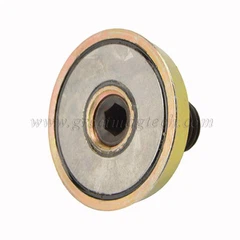
They contain a powerful magnetic core housed in a steel casing, generating a strong magnetic force when placed on a steel pouring platform or formwork platform. Using these concrete magnets is very convenient; after fixing the formwork magnet to the steel precast concrete formwork, simply press down on the knob, and the magnet will firmly hold the formwork. Pulling the knob up using a lifting rod (crowbar) is also easy.
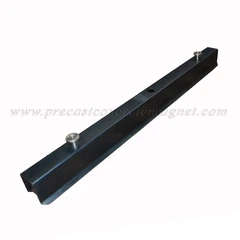
In magnetic formwork systems, formwork magnets play a central role in positioning and stabilizing side rails, edge molds, and partitions. Once activated, the magnet firmly adheres to the steel surface, maintaining alignment even during vibration and concrete pouring. This ensures dimensional accuracy and repeatable production quality.
The magnetic force of concrete magnets ranges from 450 to 3000 kg. These magnets are widely used in precast wall panels, floor slabs, beams, columns, and modular building components.

How Shuttering Magnets Work – The Magnetic Principle Explained
Magnetic Force Magnetic flux is the invisible flow of magnetic energy generated by the neodymium iron boron core inside the magnet. This flux flows in a controlled magnetic circuit. When the magnet is activated, the flux flows from the magnet to the steel plate and then back through the magnet's outer shell, forming a closed loop. The stronger and more efficient this loop, the greater the attraction.
The steel template platform plays a crucial role as the magnetic return path. Thick, high-quality steel ensures efficient flux circulation. If the steel is too thin, magnetic saturation or leakage may occur, reducing the effective attraction.
Keeping the surface clean is essential, as even tiny air gaps can disrupt the magnetic circuit. Rust, dust, or paint can significantly reduce attraction.
Key Components of a Shuttering Magnet System
The internal magnet assembly of the shuttering magnet is typically made of high-quality neodymium iron boron (NdFeB) magnets, which are the core source of the magnet's attraction. These magnets generate a strong magnetic flux, allowing the magnet to be firmly fixed to the steel template table. Each magnet box uses the same grade, but the different strengths produced by different magnet boxes are determined by the size of the magnets. Its excellent strength-to-size ratio makes it ideal for heavy-duty precast applications, especially in situations requiring extremely high vibration stability.
A steel outer shell encloses and protects the magnet core. It is not only a shell but also guides the magnetic flux downwards towards the steel plate, maximizing attraction efficiency. The carefully designed shell also resists deformation under load, extending its service life.
A switching mechanism allows for controlled activation and deactivation of the magnet. This allows operators to quickly reposition the magnet without prying or using force, improving safety and productivity.
Finally, a protective coating and durable design prevent corrosion, dust, and impact damage, helping the magnet maintain stable performance in harsh factory environments.

Factors That Affect Magnet Performance in Precast Production
Steel plate thickness directly affects the magnetic force. If the steel plate is too thin, it cannot conduct magnetic flux sufficiently, thus reducing effective attraction. Once the steel plate reaches a sufficient thickness, performance tends to stabilize. Beyond this thickness, further increases in thickness provide negligible improvement.
Surface rust, paint, oil, or concrete residue can form an insulating layer between the magnet and the steel plate. Even slight contamination can weaken contact and reduce magnetic efficiency.
Air gaps are one of the most easily underestimated factors. Small air gaps act as magnetic circuit insulation, significantly reducing attraction. Completely flat contact ensures optimal performance.
Temperature variations have a slight effect on magnetic force, especially under extreme conditions.
Installation Process of Shuttering Magnets
Surface Cleaning: Remove rust, debris, oil, or concrete residue to eliminate air gaps. A clean, smooth steel surface allows for efficient transfer of magnetic flux, maximizing attraction.
Accurate Measurement of Shuttering Magnet Distribution: Follow the template layout diagram to ensure correct spacing and load distribution. Proper positioning prevents uneven pressure and reduces the risk of magnet movement during pouring.
Check Shuttering Magnet Alignment: Checking alignment and stability is crucial before pouring concrete. Confirm that template edges are straight and magnets are fully in place without wobbling.
Safe Removal of Magnets After Curing: When safely removing magnets after curing, loosen the switch before lifting. Avoid directly prying the casing.

Advantages of Using Shuttering Magnets in Precast Production
1. Faster Installation Than Welding
Shuttering magnets significantly reduce installation time. Operators simply place the formwork and activate the magnets. This rapid fixing method speeds up mold adjustments and minimizes production downtime, especially in repetitive sheet production.
2. Higher Productivity
When formwork systems can be quickly installed and removed, production cycles are shortened, and the production process becomes more predictable. Plants benefit from smoother workflow coordination between rebar placement, pouring, and demolding. Over time, this increased efficiency translates into higher output and better labor and equipment utilization.
3. Reusable and Environmentally Friendly
Unlike welded fixtures that require cutting and surface finishing, magnets can be cleanly and efficiently removed without damaging the steel workbench. This reduces material waste, lowers maintenance costs, and supports more sustainable production methods.
4. Higher Dimensional Accuracy
Continuous holding force ensures the formwork remains firmly in place during vibration and concrete pouring. Reduced displacement means better alignment, sharper edges, and more precise precast components.
Shuttering Magnets vs Traditional Formwork Fixing Methods
|
Comparison Factor |
Shuttering Magnet |
Welding |
Bolting |
|
Fixing Method |
Activated by magnetic force with an on/off switch |
Steel components welded to the table |
Mechanical fastening with bolts |
|
Magnet vs Welding Speed |
Installation completed within seconds |
Requires welding, cooling, and grinding |
Requires drilling and tightening |
|
Magnet vs Welding Flexibility |
Easily repositioned without surface damage |
Difficult to modify once welded |
Can be removed, but time-consuming |
|
Surface Impact |
No surface damage |
Causes burn marks and requires repair |
Leaves drilled holes |
|
Time Efficiency |
Highest efficiency |
Slowest method |
Medium efficiency |
|
Reusability |
Fully reusable |
Not reusable |
Reusable but limited by wear |
|
Production Efficiency |
Significantly improves cycle time |
Reduces production speed |
Moderate impact |
|
Best Application |
High-volume precast factories |
Small or fixed structures |
Temporary or small projects |
FAQ
Q: Are shuttering magnets stronger than welding?
A: Under good steel tabletop conditions, magnetic boxes provide stable and reliable adhesion. While welding is a permanent fixing method, in most precast production scenarios, a properly selected magnetic box can fully meet the fixing requirements.
Q: Are magnetic boxes safe to use during concrete vibration?
A: Yes, with appropriate suction levels and proper placement, magnetic boxes remain stable during vibration. Steel plate thickness and the cleanliness of the contact surfaces directly affect the adhesion effect.
Q: Can magnetic boxes reduce production costs?
A: Although the unit price of magnetic boxes may be higher than welding materials, their advantages in saving labor and avoiding tabletop damage result in lower overall long-term costs.
Q: Can magnetic boxes completely replace bolt fixing?
A: In most modern precast plants, magnetic boxes can replace bolt fixing. However, in some special structural scenarios, auxiliary mechanical fixing may still be necessary.
Q: Will magnetic boxes damage the steel formwork tabletop?
A: No. Unlike welding, magnetic boxes will not cause burn marks or deformation to the steel tabletop, helping to maintain tabletop flatness and reduce maintenance costs.
Q: Which fixing method is more suitable for large-scale prefabrication?
A: For prefabrication plants that pursue high efficiency and high reusability, magnetic boxes are usually a more efficient choice.

Shuttering Magnet

Shuttering Magnetic For Vertical Mould

Shuttering Magnet Of Side Rods

Precast Concrete Shuttering Magnet
Conclusion
Shuttering magnets in precast production are more than simple fixing tools-they are precision control devices that influence efficiency, safety, and structural accuracy. When properly selected and installed, they provide a strong holding force, rapid setup, and long-term reusability. Understanding how magnetic flux interacts with steel formwork allows factories to optimize performance and reduce production risks.