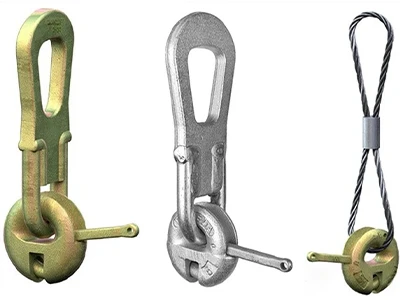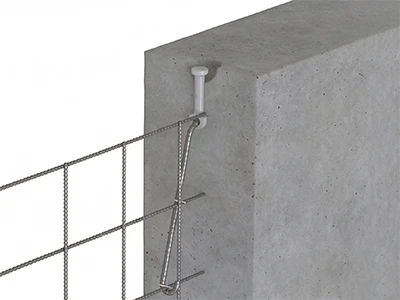
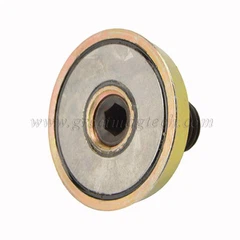


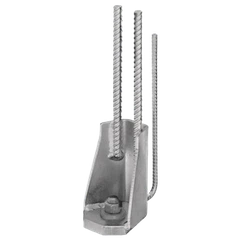
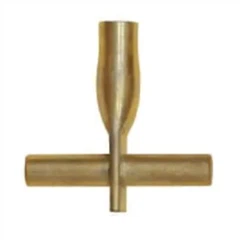
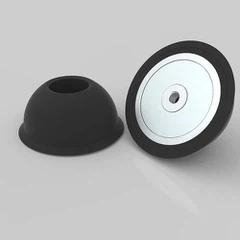
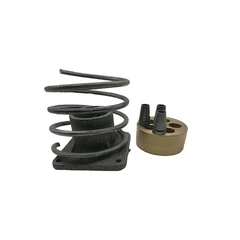

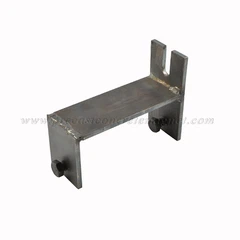
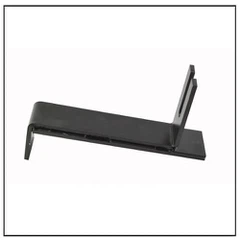


When designing the lifting of prefabricated components, it is necessary to fully consider the various processes of lifting components, including demoulding, transportation and final installation, as well as the configuration of hoisting machines and slings. Doing so we adopt the method of envelope design, model selection of the hanging nail nail in various working conditions is hung under the maximum load as the design value, choose to meet the performance of embedded after hanging nail, and then the details of the corresponding lifting requirements, including concrete strength, the Angle of the sling and the requirements of the lifting equipment, etc., the following is a need to consider the factors of model selection of the nail.
1. Hoisting method and number of lifting points
Most precast concrete members are cast in flat mold. In order to ensure the stability of component hoisting, two points embedded lifting nails are usually used for beam members and four points embedded lifting nails are used for plate members. When the bearing capacity of each lifting point cannot find the appropriate size and bearing capacity of the lifting nail, it is necessary to increase the number of corresponding lifting points, and reasonable adjustment of the sling and tooling, to redistribute the lifting load. When designing the lifting of special-shaped three-dimensional members, the position of the lifting point must be above the center of gravity of the members, so as to avoid the side turning of the members during the lifting, which will lead to safety accidents.

2. Lifting power coefficient and demoulding condition
The whole lifting and transportation is a moving process, and the design load should be amplified by considering the dynamic coefficient. The first is whether the lifting process is demoulding lifting or transportation lifting. Since the lifting speed is usually slow and the dynamic coefficient is generally small, the coefficient of demoulding lifting is recommended to be considered according to 1.1~1.2 in European specifications, and 1.2 is recommended to be considered in Chinese JGJ 1-2014 Technical Regulations for Prefabricated Concrete Structures. Secondly, in the normal hoisting and transportation process, the difference of lifting equipment will also affect the value of the power coefficient. When the most commonly used automobile crane and tower crane lift prefabricated components, the lifting power coefficient is 1.3~1.4, and the Chinese JGJ-2014 specification recommends 1.5.
In demoulding condition, when the precast member is a plate member, special consideration should be given to the adsorption force of the contact surface between the formwork and concrete. The recommended adsorption coefficient of JGJ 1-2014 is 1.5 kN/m2. In Europe, it is usually considered to be more detailed. Different adsorption coefficients are selected according to different mold materials, for example, the adsorption coefficient of the oiled steel mold is 1.0 kN/m2. Secondly, the demoulding adsorption force is related to the shape of the component itself and the shape of the contact surface. For example, when the contact surface is grid surface, the demoulding adsorption force is 3 times the weight of the component, so it should be considered according to the specific situation in the design process.

3. Sling Angle
Most hoisting operations are not equipped with balance beams or hangers and other tools, and the sling has a certain lifting Angle, which will produce tension and shear forces on the embedded hanging nails at the same time. Therefore, it is necessary to strictly limit the lifting Angle and consider the corresponding design load amplification coefficient. The limit of lifting Angle is basically the same at home and abroad, that is, the Angle between the lifting cable and the vertical should not exceed 30° and should not exceed 45°. At the same time, the tension and shear force amplification coefficient of the lifting nail is also related to the vertical Angle, that is, 1/cosβ, β is the hoisting Angle.