





Introduce
In precast concrete production, a high-quality shuttering magnet should provide a stable holding force and maintain reliable performance during pouring, vibration, and repeated long-term use. Choosing the wrong magnet can lead to formwork movement, dimensional errors, and higher maintenance costs. This article explains the key features of a high-quality shuttering magnet and helps buyers determine whether a product is truly reliable.
Quick Answer
A high-quality shuttering magnet should have a stable holding force, durable housing, smooth operation, flat bottom contact, and good corrosion resistance. The right magnet should match the casting table, formwork system, and real production conditions-not just have the highest pull force.
Stable and Accurate Magnetic Holding Force
A reliable shuttering magnet should maintain a strong holding force throughout concrete pouring and vibration. It helps keep the formwork firmly in the designed position, reduces formwork movement, and ensures higher dimensional accuracy of precast components.
For buyers, it is important not to focus only on the rated pull-force value. Always ask the supplier whether the magnet has been tested under conditions close to real production, rather than only under ideal laboratory conditions.
Strong NdFeB Magnet Core
The magnet core is the key component of a shuttering magnet. High-quality products usually use strong NdFeB, or neodymium, magnets because they can provide a powerful holding force within a compact structure.
A good magnet core should not only deliver a strong magnetic force at the beginning, but also maintain stable performance after repeated use. In daily production, shuttering magnets are exposed to vibration, impact, moisture, concrete residue, and frequent switching operations.
The reliable NdFeB magnet core should have three key features: strong initial holding force, excellent resistance to demagnetization, and stable long-term performance.
Durable Steel Housing Design
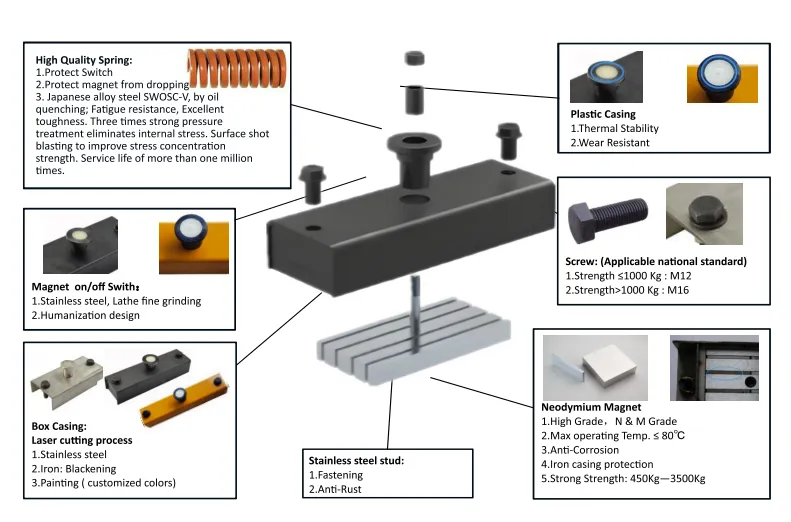
In precast concrete production, magnets are exposed to long-term impact, vibration, concrete residue, and frequent handling. A durable steel housing helps reduce deformation, protects the internal magnetic core, and prevents housing damage from affecting holding stability.
Poor welds may crack under high-frequency use. If the housing is too thin, durability will be reduced; if it is too thick, handling becomes more difficult. Therefore, a proper balance between structural strength and weight is important. A high-quality coating also improves corrosion resistance, makes cleaning easier, and extends service life.
When purchasing shuttering magnets, buyers should carefully check weld quality, housing thickness, bottom flatness, and coating quality to determine whether the magnet is suitable for long-term use in precast factories.
Smooth On/Off Switch Mechanism
The switch is one of the most frequently used parts of a shuttering magnet. In a precast factory, operators need to activate, release, and reposition magnets repeatedly. If the switch is stiff, jammed, or easily affected by concrete residue, it can reduce formwork setup efficiency.
Switch stability is also related to safety. During pouring and vibration, the magnet must remain firmly engaged. If the switch becomes loose or poorly assembled, it may weaken the holding force and increase the risk of formwork movement.
Therefore, a high-quality shuttering magnet should have a smooth, stable, and durable switch mechanism to reduce downtime, extend service life, and keep production cycles consistent.

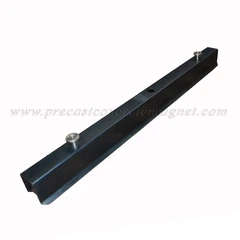
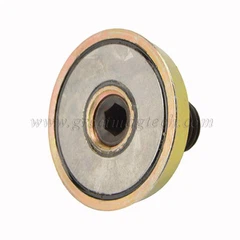
Shuttering Magnet

Shuttering Magnetic For Vertical Mould

Shuttering Magnet Of Side Rods

Precast Concrete Shuttering Magnet
Good Surface Contact and Flatness
The bottom surface of a shuttering magnet must be flat, clean, and tightly fitted to the steel casting table. Uneven contact can create small air gaps between the magnet and the steel surface, significantly reducing the actual holding force.
A high-quality shuttering magnet should remain stable on the table without rocking or shifting. This depends not only on the internal magnet core but also on the machining accuracy of the bottom plate. A precise and flat contact surface helps transfer magnetic force more efficiently to the steel casting table.

Resistance to Concrete Residue and Corrosion
High-quality shuttering magnets should have reliable coating or surface treatment to resist corrosion, wear, and humid working conditions. This protection is especially important when magnets are frequently used on wet casting tables or in high-frequency production environments, helping reduce rust, surface pitting, and housing damage.
At the same time, a smooth and easy-to-clean surface helps operators remove cement slurry and concrete residue quickly, preventing poor contact between the magnet and the steel table. Good corrosion resistance and easy maintenance not only extend the service life of the magnet but also help factories maintain a stable holding force, reduce replacement frequency, and lower long-term operating costs.
Factory Testing and Quality Control
Factory testing is an important standard for judging whether a shuttering magnet supplier is reliable. Every shuttering magnet should be strictly inspected before delivery to ensure it can meet the requirements of real precast production environments.
Pull force testing is the core inspection step. It confirms whether the magnet can reach the required holding force under controlled testing conditions.
A high-quality shuttering magnet should switch on and off smoothly and stably, without jamming, excessive resistance, or unstable release. This directly affects operator safety and production efficiency.
The inspection should also cover housing quality, welding condition, coating integrity, and bottom surface flatness.
Magnets used on the same production line should deliver stable and repeatable performance.
How to Choose a Reliable Shuttering Magnet Supplier
1. Check The Supplier's Experience In Precast Concrete Applications
First, verify whether the supplier has solid experience in precast concrete applications. Shuttering magnets are not ordinary industrial magnets; they must work in conjunction with steel formwork systems, casting beds, side rails, and repetitive production cycles.
2. Ask About The Rated Pull Force And The Real Working Performance
Rated pull force is usually tested under ideal conditions, but actual performance often depends on steel plate thickness, surface flatness, and the contact quality between the magnet and the steel plate.
3. Evaluate Customization Capabilities
Customization ability is also an important factor. Different factories may have different requirements for magnet size, housing design, switch mechanism, packaging method, and OEM branding.
4. Consider After-sales Support
Finally, consider the supplier's after-sales support. A good supplier should provide maintenance advice, replacement guidance, and professional technical communication when product issues occur.
Conclusion
A high-quality shuttering magnet is not defined by strong holding force alone. Magnetic material, housing design, switch mechanism, bottom surface flatness, corrosion resistance, safety, and quality inspection all work together to determine its real performance in precast production.
For factories, choosing the right magnet can improve formwork stability, reduce rework, protect the casting table, and support more efficient production.
FAQ
Q: What defines a high-quality shuttering magnet?
A: A high-quality shuttering magnet should provide a stable holding force, a strong and durable housing, smooth switch operation, good bottom surface flatness, corrosion resistance, and consistent performance after repeated use in precast concrete production.
Q: Is higher holding force always better?
A: Not necessarily. Holding force is important, but the right magnet should match the formwork system, steel casting table thickness, concrete pressure, and specific production conditions. A magnet with excessive holding force may be harder to operate or unnecessary for light-duty applications.
Q: Why is bottom surface flatness important?
A: The bottom surface of the magnet must fit closely against the steel casting table. If the bottom surface is uneven, air gaps can form between the magnet and the steel plate, reducing the actual holding force and increasing the risk of movement during concrete pouring or vibration.
Q: What material is commonly used inside shuttering magnets?
A: High-quality shuttering magnets usually use strong NdFeB neodymium magnets. These magnets are compact but provide very high magnetic force, making them widely used in precast formwork fixing systems.
Q: How does housing design affect magnet performance?
A: The steel housing protects the internal magnet from impact, concrete residue, and daily factory wear. A strong and well-designed housing helps maintain stability, extend service life, and prevent deformation that could damage the magnetic contact surface and reduce holding force.
Q: How can I tell whether a shuttering magnet is durable?
A: You can check the housing thickness, switch mechanism, coating quality, bottom surface finish, and relevant test data. A durable magnet should maintain stable performance after repeated switching, cleaning, and multiple production cycles.
Q: Do shuttering magnets need regular maintenance?
A: Yes. Regular cleaning and inspection help maintain holding force. Concrete residue, rust, oil, or debris on the bottom surface should be removed in time. If the housing or switch parts are damaged, they should be repaired or replaced promptly.
Q: What should buyers check before ordering shuttering magnets?
A: Buyers should check the rated holding force, actual working conditions, steel casting table thickness, magnet dimensions, switch design, packaging method, customization options, and the supplier's quality control process. A reliable supplier should help buyers ensure that the selected magnet fits their specific precast concrete production environment.