





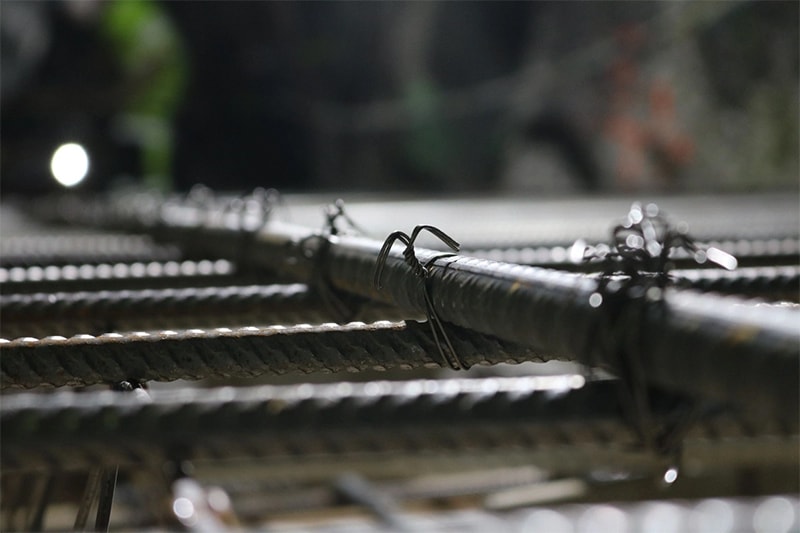
Understanding Rebar Tying
The binding and installation of reinforcement is the last and most important process in the reinforcement project. In reinforced concrete projects, formwork installation, reinforcement binding, and concrete pouring are often carried out on the same work surface to ensure quality and improve work efficiency.
The purpose of reinforcement binding is to fix the position of the reinforcement and ensure its correct position in the concrete and the thickness of the protective layer, thereby ensuring the stability and safety of the structure. In actual operation, the reinforcement binding needs to be carried out according to the specific construction requirements and design drawings to ensure that each intersection is firmly bound to avoid displacement or falling off of the reinforcement during construction.
Importance of Tying Rebar in Construction
Tying rebar is a crucial step in construction, ensuring strong and durable structures. Rebar tiers, which are machines designed to tie steel reinforcement bars automatically, efficiently, and safely, play a vital role in this process, increasing efficiency and reducing the risk of injury.
Rebar Tying Machines: Increasing Efficiency
The fully automatic rebar tying machine is a handheld battery-powered rebar fast-tying tool. It is an intelligent tool with a built-in microcontroller that can automatically complete all the steps of rebar tying. It helps workers save time by completing projects faster and performing a high number of ties in a short period. It is usually used with rebar tie wire. It is convenient and fast, and the wire output is smooth. The machine is widely used in the field of construction engineering, such as the rebar tying of beams, columns, ladders, and other components.
The fully automatic rebar tying machine is mainly composed of a machine body, a special wire reel, and a battery box. Its working principle is to drive the transmission mechanism through the motor to bring the wire into the tying clamp and complete the steel bars' tying through the mechanical structure's movement. The machine is simple and convenient to operate and can be operated with one hand, which can improve the safety factor of workers during operation, and the tying efficiency is 3-4 times that of manual tying.
Advantages and Limitations of Automated Rebar Tying Tools
Advantages
The fully automatic rebar tying machine also has a beautiful appearance and practicality. It is suitable for any rebar with a diameter ranging from 4mm to 45mm. It not only greatly improves work efficiency, but also reduces the labor intensity of workers, ensuring the uniformity and stability of the quality of the operation tying.

Rebar tying machines deliver accurate and effective ties with each pull of the trigger they use about a third of the wire needed for manual tying jobs, reducing time spent replenishing wire suppliesRebar tying machines produce less mess than tying rebar by hand, cutting down on cleanup time and effort they reduce the risk of worker injury or burnout, improving occupational safety
The automatic steel bar tying robot can be used in different scenarios, such as ordinary cast-in-place concrete slabs, basement large bottom slabs, etc., to adapt to the allowable spacing error of steel bar placement, and automatically complete horizontal steel bar tying.
Limitations
Cost issues: The price of automatic rebar-tying robots is relatively high.
Uneven quality: Due to the existence of many imitation products on the market, the quality of automatic rebar-tying robots is also uneven.
Maintenance and repair: As an automated device, the automatic rebar tying robot may require professional maintenance and repair, bringing additional costs and complexity.
Technical adaptability: Despite the continuous advancement of automatic rebar-tying robot technology, manual tying may still have irreplaceable advantages in some complex rebar structures or tying work with special requirements.
Manual Rebar Tying
Manual steel bar bundling refers to placing steel bars at the required position and spacing by manual operation during the construction process, and bundling and fixing them with wire or binding tape to form an integral structure. This work usually requires the use of some special tools, such as lead wire hooks, small crowbars, and torque wrenches. Compared to hand tying, using mechanical tools can reduce musculoskeletal injuries and improve productivity and cost savings.
There are many methods of manual steel bar bundling, including single-strand bundling, double-strand bundling, one-side buckle bundling, cross buckle bundling, reverse cross buckle bundling, pocket buckle bundling, and twist buckle bundling.
In short, manual steel bar bundling is a highly technical job that requires not only skilled operating skills but also strict compliance with construction specifications and quality requirements to ensure the safety and stability of the building structure.
Manual Rebar Tying Tools
Rebar wire tie: A simple tool used to twist and wrap the wire around the rebar. It usually consists of a handle and a hook.
Rebar pliers: This type of pliers is specifically used for cutting and tying rebar. They usually have a side cutter for trimming excess wire.
Wire twisting tool: Similar to the wire twister, the wire twisting tool uses a spiral motion to twist the wire, resulting in a tighter and more secure tie.
Advantages and Limitations of Manual Tools:
Advantages:
Simple construction: Manual tying is a common method, which is simple to operate easy to use, and suitable for smaller-scale projects.
High flexibility: When using tools such as tying hooks and wrenches for small tying work, it is flexible and convenient, and can adapt to different construction environments and needs.
No damage to steel bars: In some cases, manual tying will not damage the steel bars, which is beneficial under specific construction conditions.
Limitations:
Low efficiency: Due to the need for manual repeated squatting and operation, the efficiency is low, and it is easy to miss the binding.
High labor intensity: Workers need to perform physical labor for a long time, which is easy to cause physical injuries.
Unstable quality: The quality of manual tying is often difficult to guarantee, and it is easy to loosen or tie loosely.
High cost: Manual tying requires a lot of labor input, which increases the construction cost.
Comparing Rebar Tying Methods
Comparison Items
| Project | Rebar tying machine | Manual binding |
| Production efficiency |
A fully automatic steel bar bundling machine can significantly improve production efficiency through computer control equipment. Fast bundling speed, 2-turn bundling time is less than 0.85 seconds, 3-turn bundling time is less than 0.90 seconds. |
Manual bundling requires a large number of workers to participate, resulting in high labor intensity and low production efficiency. For example, in some large-scale projects, manual processing requires a large number of workers and is difficult to manage. |
|
Cost saving
|
The fully automatic steel bar bundling machine significantly reduces labor costs. It also reduces material waste and improves economic benefits. | The cost of manual bundling is high because a large number of workers are required. |
|
Labor intensity and working environment |
The fully automatic steel bar tying machine significantly reduces labor intensity, reduces workers' physical exertion, and reduces the incidence of errors.
|
The labor intensity of manual tying is high, which can easily cause worker fatigue and work-related accidents. In addition, manual processing will cause construction noise and environmental pollution problems. |
|
Quality control and safety |
The intelligent steel bar installation and binding system combines infrared technology and automated robotic arms to automatically grab, install, and bind prefabricated steel bars to ensure that each steel bar is tightly connected. |
The quality control of manual binding is more difficult and prone to omissions and errors. |
|
Environmental impact |
The fully automatic steel bar binding machine is more energy-saving and environmentally friendly, reducing noise and pollution at the construction site. |
The manual processing process will generate greater noise and pollution, which will hurt the environment. |
Choosing the Best Rebar Tying Solution
When choosing between manual and automatic rebar tying tools, consider the size and complexity of your construction project and the importance of speed, accuracy, and safety during rebar tyingLook for a rebar tying machine with an ergonomic design and lightweight construction to reduce fatigue and discomfort consider the cost and availability of cords and other consumables when selecting a rebar tying tool or machine