



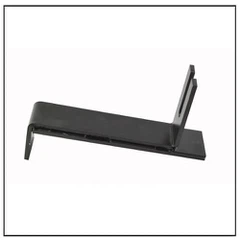


Potential Safety Hazards During Lifting:
Adequate safety measures need to be taken at all times when working with heavy-duty precast concrete products. Failure to use proper lifting tools or techniques can result in product damage, cracking, damage to other products or machinery, and in the worst-case scenario, accidental injury to personnel.
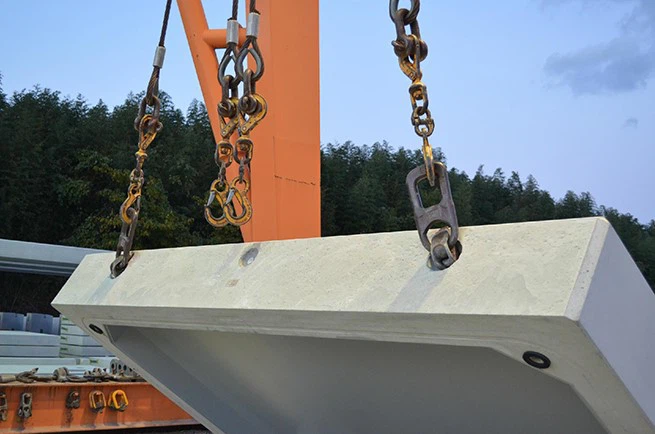
During transportation, concrete products are usually loaded onto transport trucks, with truck pallets typically ranging in height from 1 to 1.5 meters. Any precast concrete product dropped from this height cannot ensure its integrity and functionality.
Some Proper On-site Lifting Techniques:
1. Clamp Lifting
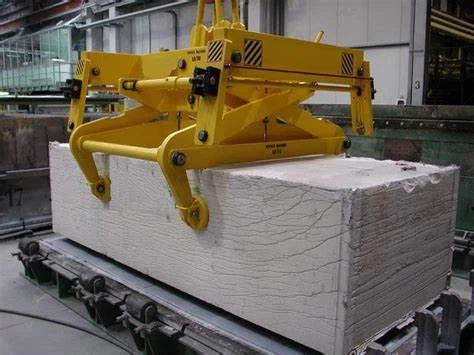
For certain elements, such as concrete sleepers and concrete curb units, heavy-duty clamping devices can be used. Clamps are often filled with rubber to prevent scratches on the concrete surface. When lifting, the clamping device is connected to the hook through a chain. Once lifting begins, the gripping force of the clamp on the product increases accordingly under the pull of gravity.
2. Vacuum Lifting
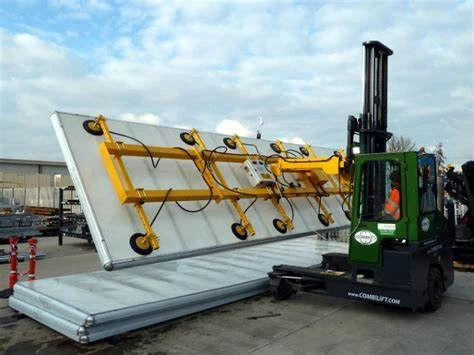
Vacuum suction cranes use powerful suction through vacuum pads to lift heavy products with relatively flat surfaces, such as large concrete slabs. Applicable products generally weigh less than 500 kg. Vacuum lifts come in many types and sizes, ranging from a small hand-held lifting device to a large vacuum lifting tray/bed attached to a crane.
The advantage of using a vacuum lift is that it can achieve "invisible" lifting without setting any physical lifting points on the product. When using a vacuum lifting device, the lifting point must be accurately placed in the center of the product to ensure even and reasonable weight distribution when lifting the product. During the lifting process, the suction cups should remain in full contact with the product surface, because once the adsorption force weakens, the risk of the hanging parts falling will increase dramatically.
3. Sling Lifting
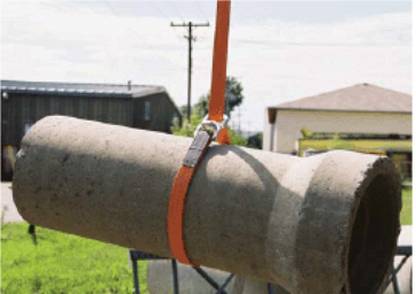
Sling spreaders are made from durable polyester woven material and are available in load ratings from 2.0 to 10 tons. Depending on the product's shape, certain items can be lifted with a sling without the need for a special lifting point. Additional rubber pads or blanket-like materials can be added to the sling to reduce the chance of marking or product damage
4. Lifting Inserts and Keys
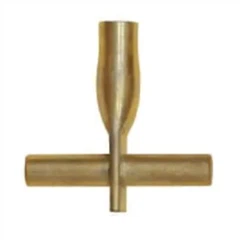
Prefabricated components are embedded with metal hanging nails in advance before pouring, and the lifting operation is completed through special hooks and spreaders. Lifting keys must be used during hoisting to prevent safety accidents. During the lifting process, the spreader is connected to the sling chain and hooked to the lifting nail, and the other end of the sling is fixed at the lifting center point. It should be noted that the angle between the sling and the vertical cannot exceed 45° and should not exceed 30°.

5. lifting clutch and ring clutch system
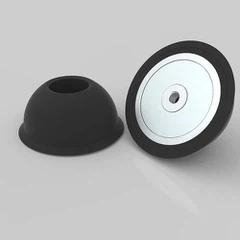
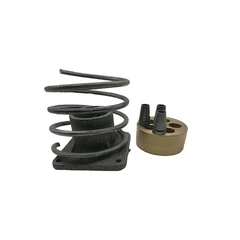
The lifting system can safely and effectively lift and carry all types of precast concrete components, including precast concrete beams, floor slabs, wall panels, pipes and other components. The Ring clutch lifting system is equipped with flat steel lifting embedded parts, and the lifting clutch lifting system is equipped with round-head embedded lifting nails, which can realize quick connection and release functions during the actual lifting process. Ring clutch hoisting embedded parts (hanging nails) have a wide range of applications and can be used in different components, such as floor slabs, columns, walls, or beams, without restrictions on the direction of the load. The lifting clutch solution can use a hemispherical groove former (Figure 1) to form a general spherical groove ( Figure 2) on the surface of the component after concrete pouring, so that the lifting part can be easily hidden after the lifting is completed.
| Ring Clutch System | Lifting Clutch |
| Quick link and release | Quick link and release |
| Includes all lifting load directions | Includes all lifting load directions |
| Allowable lifting load: 2.5-26 tons | Allowable lifting load: 1.3-32 tons |
| Easy to install, slotted to prevent embedded parts from protruding | Easy to install, slotted to prevent embedded parts from protruding |
 |
 |
| Figure 2 | Figure 1 |
Hidden Embedded Lifting Parts
Landscape or building component products installed above the ground can have lifting points in the visible area on the inside. Often these lifting points no longer function after installation, and project clients often use a variety of additional materials and work hours to hide the lifting points after the lifting is completed. In projects using Peikko's KK lifting solution, the hemispherical groove former hides the reserved lifting parts more conveniently and quickly after the components are hoisted than traditional measures. This avoids cutting off embedded parts later.

When Did You Start Thinking About Lifting?
Consideration should be given to lifting early in the project. The handling and transportation of components should be considered early in the project process, especially for custom or unconventional types of products. During the drawing process of custom product workshop construction drawings, the design team should set up transportation and lifting points on the surface of the delivered product that is most logical and practical. If the customer wishes to use a certain lifting technology or has special requirements for lifting points, coordination, and communication must be carried out during the design development stage. As a rule of thumb, it is the customer's responsibility to be aware of any lifting restrictions, on-site site access-related issues, and any factors that may affect the transportation and delivery of the product. Peikko has a professional team of engineers who can provide hoisting consultation to owners in the early stages of the project, coordinate hoisting plans during the design stage, and design and calculate specific hoisting technical solutions for projects using Peikko's hoisting plan. The engineering team can arrive at the site anytime for technical support.