







In daily life, magnets are a very common thing. And thousands of years ago, the working people of our country made the compass, one of the four great inventions, according to the characteristics of the magnet. Magnets are a very useful thing to this day. From all kinds of special electronic equipment to the usual teaching aids and toys, magnets can often be seen. The picture below shows a horseshoe-shaped magnet, and the lump of metal attached to it is gadolinium (sound gá). This is an element that, like iron, cobalt, and nickel, is attracted to magnets and is currently widely used in the field of enhanced MRI.
However, due to the nature of ferric oxide itself, its attraction to iron objects is not too strong, and its magnetism will gradually weaken over time. In this case, how can we make a magnet that is stronger and less prone to decay? Under this premise, NdFeB magnets came into being.
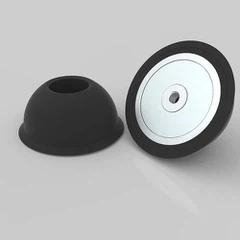
This kind of magnet with anti-corrosion treatment and shiny surface is NdFeB magnet, its chemical formula is Nd2Fe14B. The most commonly used NdFeB magnets are made of neodymium, iron and boron sintered at high temperature, and are the most magnetic artificial magnets so far. If the core element of traditional triiron tetroxide is iron, then the reason why NdFeB magnets have such strong magnetic properties is the effect of neodymium element. The metals in the picture below are neodymium:

Neodymium is the fourth element in the lanthanide family of rare earth elements, and like iron, cobalt, nickel, and the aforementioned gadolinium, can itself be attracted to magnets. In addition, neodymium is more active in the lanthanide series, so it is as easily oxidized as iron, which is why the surface of the neodymium iron boron magnet is coated. If neodymium is used to enhance magnetism, then the role of boron cannot be underestimated. This black thing is boron:

In the periodic table, boron is located to the left of carbon, so boron chemistry similar to carbon-centered organic chemistry has recently emerged. In NdFeB magnets, boron is equivalent to a mediator of neodymium and iron. While ensuring the stability of its molecular structure, boron greatly expands the maximum magnetism that a substance can produce, making the entire magnet extremely high in magnetic performance, even allowing it to pick up objects 640 times its own weight.


