




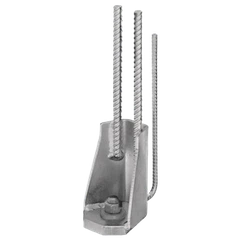
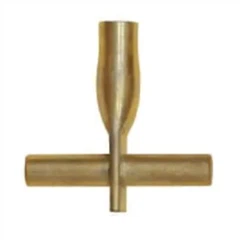

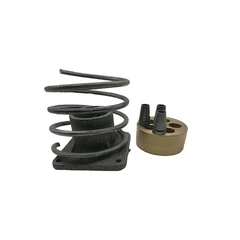

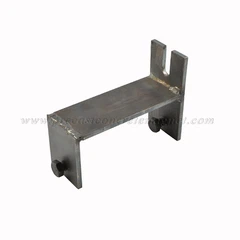


Precast concrete members usually have a large deadweight and a large variety of component shapes, so there are a variety of embedded hanging nails that can be used. At present, there is no special specification on the performance requirements of embedded hanging nails, usually referring to the requirements and practices of Europe and America. Among them, the development of prefabricated structure in Europe has been very mature, and the requirements of the corresponding prefabricated component lifting and embedded lifting nail system are relatively standardized. There is a set of relatively completed certification methods and processes. For example, all the lifting systems of Pecker Company have complete test certification and obtained the European CE certification. It meets the performance requirements of European mechanical code MD2006/42/EC and German national code VDI/BV-BS 6025, that is, the safety factor of the lifting nail itself is more than 3.0 times, the safety system of the lifting gear is more than 4.0 times, and the safety factor of the lifting against the damage of concrete is more than 2.5 times. The following describes the commonly used prefabricated lifting systems in civil and industrial fields. There is no strict application boundary between them, but each has its own corresponding characteristics, especially in some special components and lifting environment, choosing the right lifting system will get twice the result with half the effort.
1. Round head lifting nail system
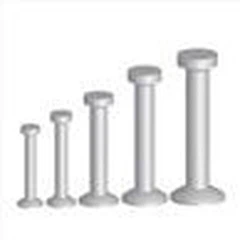
The round forging head is used for the hook, and the special duck beak buckle spreader is equipped to realize the fast hook. The lifting load is transferred to the concrete through a circular end anchor at the other end of the lifting nail. The installation requires the use of a hemispherical rubber to secure the lifting nails and form hemispherical grooves on the concrete surface so that the lifting gear can be caught and lifted.

The round-headed spike system is characterized by rapid lifting, especially hooks and unhooks, and is ideal for conventional residential prefabricated elements and industrial buildings. The maximum service load of a single spike is 32T. The lifting Angle (the Angle is the Angle between the steel wire rope and the vertical, the same as below) is required when the round head lifting nails are used, which should be controlled within the range of 0~45°. Under the requirements of some special municipal components, 90 degree lifting can also be used, at this time, the bearing capacity of the round head hanging nail needs to be reduced by nearly 50%. Since the part of the round head hanging nail embedded in the concrete has the end anchor, it is usually necessary to configure additional
Strong reinforcement bars to prevent damage to concrete during lifting.

2. Screw hanging system
The ends of the threaded embedded lifting nails are tapped by steel pipes, and the special lifting tools are equipped with external threads, which need to be screwed into the lifting nails sleeve when lifting. The extruded steel bar at the other end of the casing will lift the load to the concrete. The commonly used methods are steel bar straight anchor, curved anchor, and steel plate end anchor.

The threaded embedded nail system can be used in addition to conventional prefabricated components, but also for some thin-walled components, such as thin prefabricated wall panels and floor slabs. There is no need to form special grooves in the concrete surface when the hanging nails are installed, and the installation and fixation are very simple. The supporting crane has steel wire rope and soft cable spreader and universal spreader. It should be noted that the soft cable spreader can not be used for flipped hoisting of members.

3. Plate lifting nail system
Plate type embedded hanging nails are made of steel plate processing, through the end of the hole hook, its special hanger with a rotating pin, in the hook need to rotate the pin to prevent falling off. Flat plate lifting nails need to be fixed with a flat spherical shaper to form grooves in the concrete for lifting hooks.

The bearing capacity of the plate hanging nail is different between the plane and the outside, so the directionality should be considered when arranging. In addition to being widely used in ordinary prefabricated components, flat plate hoisting nails are very suitable for wall panel hoisting of the hoisting system. The rotating pin end of the supporting spreader can pass through the rope. After the component is hoisted into place, the hoisting personnel only need to pull the rope on the ground to unhook, without working at high altitude, which greatly reduces the safety risks.


